The explorer trio has another apple-pie question. The supplied pictures imagine the afternoon; the labelled fraction guide below shows exact equal parts.
1. One pie, many pieces
Leo had barely closed his notebook about circles when a new question arrived.
It arrived on a plate.
The apple pie had cooled, and a grown-up had cut it into slices. Leo looked at the spaces between them.
“It was one pie,” he said. “Now it’s lots of pieces. What numbers do we use for those?”
Gidget put down his pencil.
“Before we count pieces, let’s decide what we’re counting pieces of.”
“The pie?”
“Exactly. For this question, one complete pie is our whole.”
Pip sniffed the air. He seemed to think the whole pie was an excellent idea.
“We’ll keep that for people,” Leo told him. “Your cat treat is coming.”
2. A fair-looking mistake
At a clean table away from the workshop experiments, Gidget drew a pie on paper. He divided it into a tiny wedge and a very large wedge.
“Two pieces,” said Leo. “Two halves?”
He paused.
“Wait. That little one wouldn’t be a fair half.”
Gidget nodded. “To make halves, we divide the whole into two equal parts. Two pieces alone aren’t enough.”
He drew another circle and a straight line through its centre. This time the two sides matched.
Leo covered one side with his hand.
“One of the two equal parts. That’s one half.”
Gidget wrote 1/2 beside it.
“A fraction,” he said. “A number that can tell us how much of a whole we have.”
Pip placed one paw on the tiny wedge and one paw on the enormous wedge.
His paws were equally pleased. The wedges were still unequal.
3. The apple on the blue plate
A grown-up brought an apple, washed it, and cut it into two roughly equal halves. Then each half was cut into two roughly equal pieces again.
Four apple pieces rested on a blue-and-white plate.
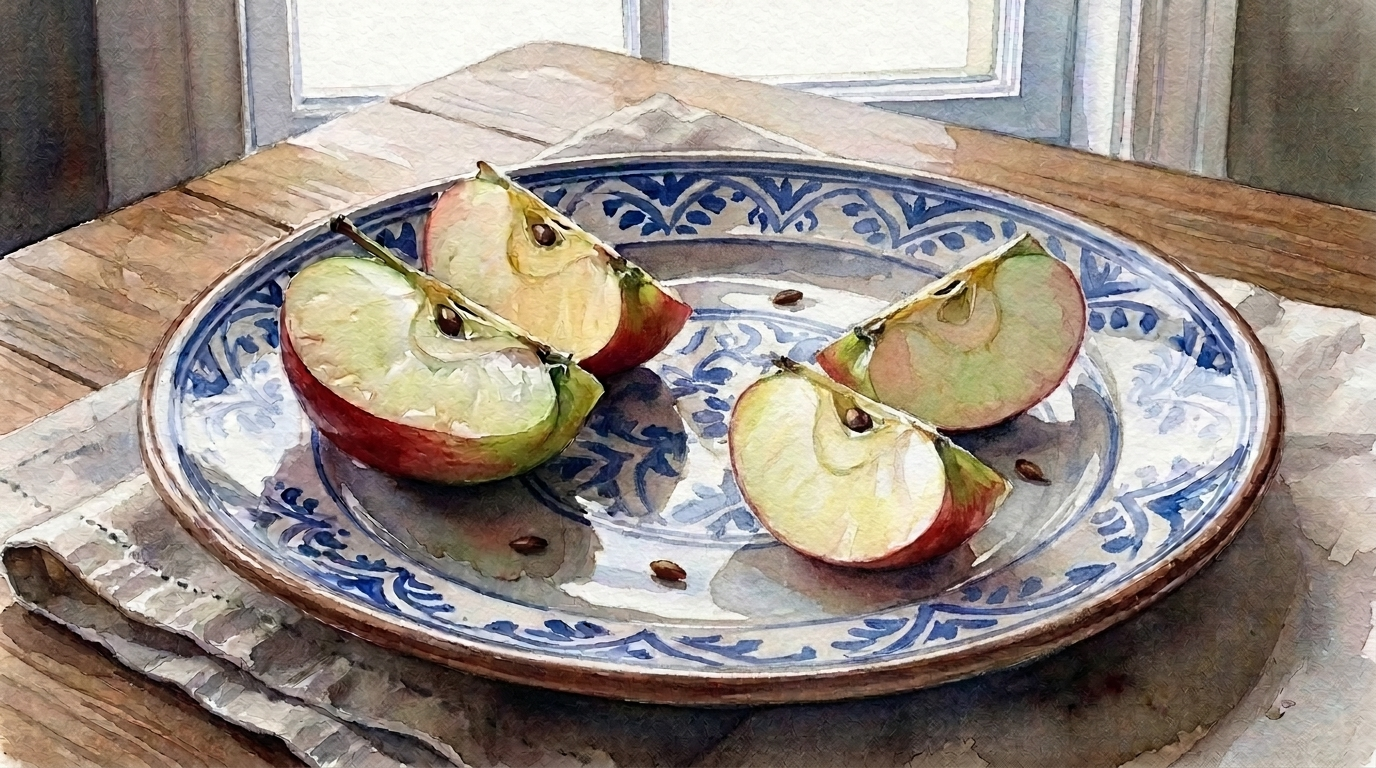
Four pieces of apple inspire the question. Real fruit and painted illustrations are approximate; a quarter means one of four equal shares of the chosen whole.
“What shall we call the whole this time?” asked Gidget.
“One apple,” said Leo. “Not the plate!”
“Good. If we divide that apple into four equal shares, each share is one quarter, also called one fourth.”
He wrote 1/4.
Leo counted the pieces. “One quarter, two quarters, three quarters, four quarters.”
“And all four together?”
“The whole apple again. Even if we can’t stick the skin back together.”
Gidget drew four equal boxes beneath his circle.
4/4 = 1 whole
The pieces had changed their places. The amount of apple had not grown.
4. Two numbers with two jobs
Leo inspected 3/4 in the notebook.
“Why does a fraction need two numbers?”
Gidget pointed to the bottom number.
“The denominator tells us how many equal parts make the whole in this model. Four means quarters.”
Then he pointed to the top number.
“The numerator tells us how many of those parts we are counting. Three means three quarters.”
Leo drew four equal squares in a row and coloured three.
“So the four names the size of the parts, and the three counts them.”
“Exactly.”
“What about the uncoloured square?”
“One quarter. Together, the three coloured quarters and the one uncoloured quarter make four quarters: one whole.”
Leo wrote:
3/4 + 1/4 = 4/4 = 1
Pip looked at the pencil moving, then at Gidget.
He was waiting for the numerator of his cat treats to increase.
5. The half that wore another name
Gidget folded a paper strip into two equal lengths and coloured one half.
Then he unfolded it, folded each half in half, and opened the strip again.
Now there were four equal sections. Two were coloured.
Leo frowned. “You made more pieces.”
“Did I colour any more paper?”
“No.”
“Then how much is coloured?”
Leo laid a finger across the same coloured length.
“One half. And two quarters!”
Gidget wrote:
1/2 = 2/4
“Two names for the same amount. We call them equivalent fractions.”
Leo imagined the half wearing a little badge that said TWO QUARTERS.
“A new name,” he said, “without a bigger lunch.”
He drew two quarters side by side.
1/4 + 1/4 = 2/4 = 1/2
“We’re counting quarters,” Gidget said. “One quarter and another quarter make two quarters.”
6. The bigger number and the smaller bite
Leo drew two matching paper pies. He divided one into two equal pieces and the other into four.
“Four is bigger than two,” he said. “So is one quarter bigger than one half?”
He looked again before Gidget could answer.
The quarter was clearly smaller.
“Oh. More equal pieces means each piece has to be smaller—if the whole stays the same.”
“That last part matters,” said Gidget.
He drew a very small pie beside an enormous pie.
“Half of this little pie might be less food than a quarter of that enormous one. To compare actual amounts, we must know the size of the whole.”
Leo circled the matching paper pies.
“For the same-sized whole: one half is bigger than one quarter.”
Pip studied the enormous drawing with interest.
It was, regrettably, still made of pencil.
7. A path from nothing to one
Gidget drew a short path in the notebook. One end was marked 0, the other 1.
He divided the distance between them into four equal steps.
Leo followed with his pencil.
“One quarter. Two quarters. Three quarters. Four quarters.”
“Where is one half?”
Leo tapped the middle mark, at two quarters.
“Here. It has both names again!”
Fractions were beginning to feel less like mysterious numbers stacked on top of each other. They were amounts Leo could point to, compare, and find on a path.
He drew a tiny flag at one.
“Do fractions stop at a whole?”
“No,” said Gidget. “Five quarters would be one whole and another quarter. Today we’re exploring the part of the path from zero to one.”
Leo left room beyond the flag for another afternoon.
8. A discovery worth sharing
The grown-up brought Leo a small slice of pie. Pip received his usual cat treat. Gidget received a drawing of a slice, which fitted neatly inside his notebook.
“Is every piece of this real pie exactly equal?” Leo asked.
“Probably not exactly,” said Gidget. “Real cutting is approximate. Our paper models help us see the idea clearly.”
Leo looked at the blue plate, the paper strip, and the path of little marks.
“An apple can have quarters. A strip can have quarters. Even a distance can have quarters.”
“As long as we choose the whole and divide it into equal parts.”
Leo wrote that down. Then he added:
First find the whole. Then check the parts are equal. Then count the parts you mean.
Pip settled beside the notebook with a satisfied purr.
One whole afternoon had become a collection of little discoveries.
And none of them had been lost by sharing.
Gidget’s fraction field guide
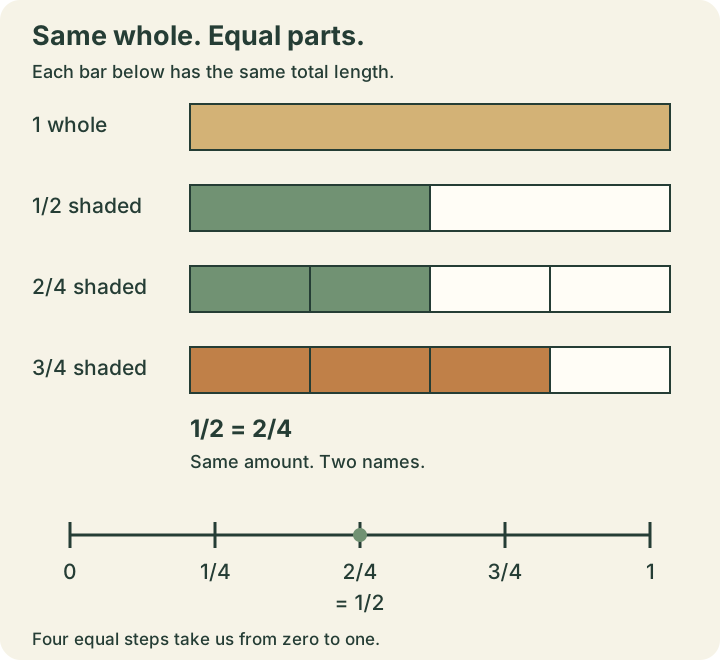
Whole: the complete amount chosen as one. Equal parts: shares with the same amount of the quantity being measured. Numerator: the top number; counts the parts included. Denominator: the bottom number; names the equal-sized parts in this model.
One half = two quarters. The same fraction can have different names. The equal-length bars show why 1/2 = 2/4 without changing the whole.
Try it: a paper picnic
- Take three matching rectangular paper strips. Keep the first as one whole. Fold the second into two equal lengths and the third into four equal lengths. Check the ends line up before making each crease.
- Colour one half of the second strip. Colour two quarters of the third. Place them beneath the whole strip with their left ends aligned. Do the coloured lengths match?
- On the quarter strip, point to one quarter, two quarters, three quarters, and all four quarters. Which two names describe the middle point?
- Draw a line from 0 to 1. Divide its length into four equal steps. Label 1/4, 2/4, and 3/4; add 1/2 beneath 2/4.
- Draw a circle with two very unequal pieces. Explain why they are two pieces but are not two halves. You can do the entire activity with paper; any food cutting belongs to a grown-up.
Questions for curious explorers
- Is every piece one half when you cut something into two pieces?
- In 3/4, what do the three and four tell us?
- Why do 1/2 and 2/4 describe the same amount?
- For the same whole, which is larger: 1/2 or 1/4?
- If you have three quarters, how much more completes the whole?
Open Gidget’s answer notebook
- No. Halves must be two equal shares of the whole.
- Four tells us the whole is divided into four equal parts; three tells us we are counting three of them.
- Dividing each half into two equal parts makes quarters. The same coloured half now contains two quarters, without adding any coloured area or length.
- One half. Dividing the same whole into more equal parts makes each unit part smaller.
- One quarter. Three quarters plus one quarter makes four quarters, or one whole.
A note for grown-ups
This story introduces fractions through part–whole, length, and number-line models. The pictures are decorative illustrations; the apparent sizes or number of pie slices should not be treated as exact fraction data. The apple pieces suggest quarters, but perspective, irregular fruit and hand-cut shares prevent exact comparison from the image. The original labelled diagram uses equal-length bars for precision.
For these models, choose a consistent whole, divide it into equal amounts, and count the selected parts. Equal shares need not have identical shapes. The numerator counts the chosen unit fractions; the denominator names their size. Comparisons of physical quantities require the same-sized whole. For positive unit fractions of the same whole, a larger denominator means a smaller part; this is not a general rule for comparing fractions with different numerators.
The examples stay mostly between zero and one, but fractions can be greater than one, zero, or negative. A denominator cannot be zero. Addition here combines equal-sized units, so 1/4 + 1/4 = 2/4; we do not add the denominators. Later lessons can connect fractions with division, ratios and multiplication without crowding this first encounter.
The trio is fictional. Practical exploration uses paper; food should be prepared on a clean surface away from laboratory materials, and pets receive their own suitable food.
For further reading: OpenStax Prealgebra 2e: Visualize Fractions, covering equal parts, numerator and denominator, equivalent fractions, and number lines.