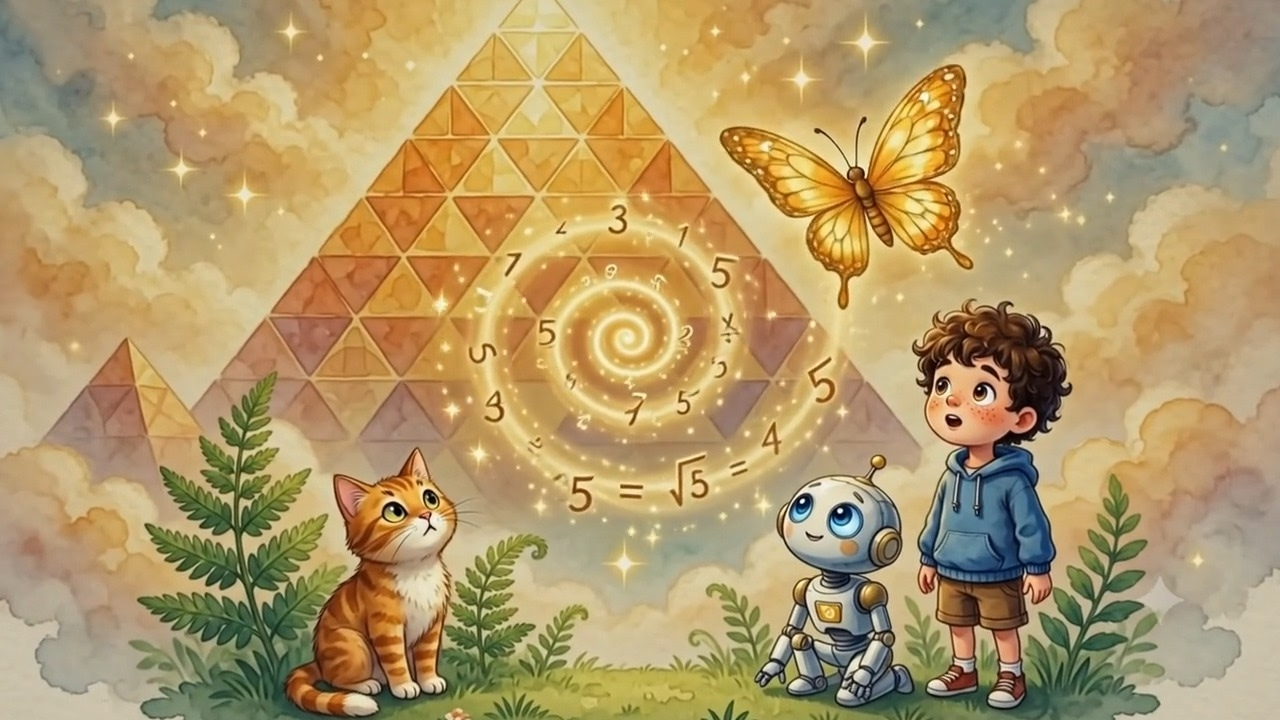
Our doorway into an imaginary garden. The symbols in this supplied illustration are decorative; use the story below for the mathematics.
1. A question in a pocket
Leo had a pebble in his pocket and a question in his head.
“Why do we have to learn numbers?” he asked. “They only live in schoolbooks.”
Gidget, his little robot, blinked twice.
“Only in schoolbooks?”
Pip the cat flicked his tail. Something golden fluttered above the fern beside him.
A butterfly!
Leo followed it between the leaves. Gidget pattered after him. Pip followed because following butterflies was a very important cat job.
Beyond the fern stood a pyramid made of glowing triangles. A spiral of light curled in the air like a question mark that had forgotten when to stop.
“Welcome,” whispered the butterfly, “to the Garden of Hidden Numbers.”
Leo checked his pocket. His pebble was still there.
His question suddenly felt much bigger.
2. The bridge that wanted a count
A stream crossed the path. Smooth stones made a little bridge.
Leo pointed to each stone once.
“One, two, three, four, five.”
“Five stones,” said Gidget. “The last number tells us how many.”
Leo counted the stones again, starting at the other bank. Still five!
“Changing where you start doesn’t change how many stones there are,” he said.
Pip stepped across without counting anything aloud.
“Cats may keep their mathematics private,” Gidget said.
Leo laughed. Then he took out his pebble.
“One pebble. Five stepping stones. Numbers were here before I opened a schoolbook.”
“The things were here,” said Gidget. “Numbers help us describe how many.”
3. Four wings and no biscuits
The butterfly settled on a leaf and spread her wings.
“Two on this side,” Leo said. “Two on that side. Four altogether!”
“Butterflies have two pairs of wings,” said Gidget.
Leo held out his hands like wings. Pip lifted one paw, then decided that was enough flying for today.
“One butterfly. Four wings,” Leo said. “I have to say what I’m counting.”
His stomach rumbled. He opened his biscuit tin.
Empty.
“Oh,” he said. “How many biscuits is that?”
“Zero,” said Gidget gently. “Zero tells us there are none.”
“A very disappointing number,” Leo said.
Gidget offered him an apple from their picnic bag. One apple was much better than zero biscuits.
4. The flower that surprised the robot
Beside the path, Leo found a little buttercup.
Without picking it, he counted its petals.
“One, two, three, four, five!”
Gidget’s eyes glowed. “Five! I have seen five in a special number pattern.”
“Then every flower must have five petals!” Leo guessed.
They hurried to the next flower.
It had four.
Leo looked at Gidget. Gidget looked at the flower.
The flower continued being a flower.
“Our guess needs fixing,” Leo said.
“Excellent noticing,” said Gidget. “Flowers can have different numbers of petals. We should count what is there.”
Leo drew both flowers in his notebook. He liked the four-petalled one just as much.
5. The add-the-last-two game
At the golden pyramid, the glowing spiral dipped toward the ground. Beneath it lay a row of empty circles.
“A puzzle!” said Leo.
Gidget placed one fallen leaf in the first circle, and one in the next.
“For each new circle,” he said, “add the numbers in the two circles just before it.”
Leo tried.
“One plus one makes two.”
He made a group of two leaves.
“One plus two makes three. Two plus three makes five!”
Pip sat beside the next empty circle.
“Three plus five makes eight,” Leo said. “Please move your tail. I need room.”
The row now read:
1, 1, 2, 3, 5, 8
“Five plus eight makes thirteen!” Leo cried.
“This is part of the Fibonacci sequence,” said Gidget. “A sequence is a list in order. This one has an add-the-last-two rule.”
“Does the garden count leaves into circles?”
“We made this game,” said Gidget. “But some real plants have patterns connected to these numbers.”
6. The sunflower’s winding paths
The butterfly led them to a sunflower with a broad seed head.
“Look closely,” said Gidget.
Leo saw the seeds. Then he saw something else: curving rows winding one way, and other rows winding the other way.
He traced one row in the air, without touching the seeds.
“Spirals!”
“In many sunflowers, the numbers of spiral rows in the two directions are neighbours in the Fibonacci sequence,” said Gidget. “That can happen because of the way the tiny flowers that later make seeds are arranged as the head grows.”
Leo studied the seed head.
“Can we tell the numbers just by seeing that it’s round?”
“We have to count the rows,” said Gidget. “And real plants don’t always match a neat pattern.”
Leo opened his notebook again.
Under his flowers, he wrote:
Look first. Count carefully. Let surprises in.
7. What came home
The golden light softened. The pyramid faded into evening clouds. The butterfly fluttered back through the fern.
Leo, Gidget, and Pip were home.
On the doorstep sat two shoes. Beside them lay a fallen leaf. Pip curled his one tail around his paws.
Leo took the pebble from his pocket.
“One,” he said.
“Still think numbers only live in schoolbooks?” asked Gidget.
Leo shook his head.
“We can use them to notice things. How many. What repeats. What changes.”
He opened his notebook to a fresh page.
At the top, he wrote:
What numbers will I find tomorrow?
Then he checked the biscuit tin once more.
Still zero.
Some discoveries needed a grown-up’s help.
Your turn: become a number detective
- Find three things you can count. Say what you are counting, and touch or point to each thing once.
- Look at two flowers without picking them. Do they have the same number of petals? Draw what you find.
- Continue the pattern: 1, 1, 2, 3, 5, 8, __, __. Explain your rule to someone.
- Find a spiral. Is its shape enough to prove it follows the Fibonacci pattern? What else would you need to check?
Open the puzzle answers
The next numbers are 13 and 21: 5 + 8 = 13, then 8 + 13 = 21. A spiral shape alone does not prove a Fibonacci relationship. For a sunflower, you can investigate by carefully counting the spiral rows in each direction.
A little note for curious minds and grown-ups
Counting numbers and numbers in nature: We count whole things with 1, 2, 3, and so on. These are often called natural numbers. Some books include 0 among the natural numbers and some begin at 1. Zero means none. “Numbers occurring in nature” means quantities or patterns we can observe; it is a broader idea than the mathematical name “natural numbers.”
Fibonacci numbers: The sequence is often written 0, 1, 1, 2, 3, 5, 8, 13, 21, … . The leaf game starts with the two 1s. Each later number is the sum of the previous two. Some plants show related petal counts or spiral-row counts; this is not a rule for every plant or every spiral. Four is a perfectly good natural number even though it is not a Fibonacci number.
Real and imagined: Counting, butterfly wing pairs, and plant patterns are real. The talking butterfly, enchanted pyramid, and glowing number portal belong to our story. The supplied artwork includes decorative symbols, including an incorrect equality involving 5 and √5. That equality is not a mathematical fact: √5 is about 2.236, not 5. We use the picture for imagination and the written examples for learning.
Explore further: The Royal Institution’s Numbers of Nature activity · University of Surrey: Fibonacci numbers and plants