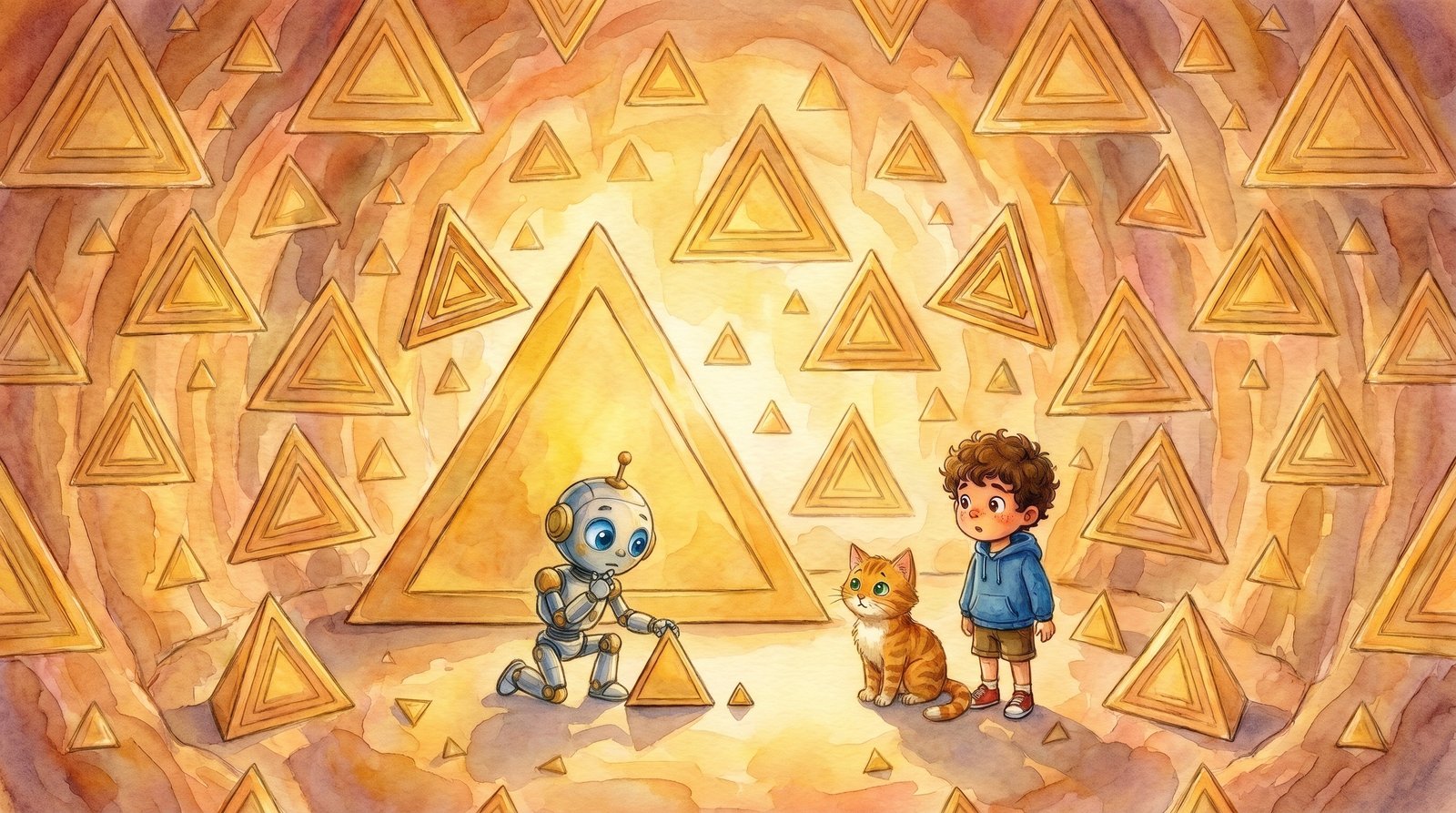
The trio enters an imaginary triangle hall. Their discoveries about flat triangles and measuring are real mathematics.
1. Three sticks and a doorway
Leo found three straight sticks beside a fallen branch.
“A doorway!” he announced, laying them end to end.
There was a gap.
Pip put his nose through it.
“A doorway for a cat’s nose,” said Gidget.
Leo moved the sticks until their ends met. Now they enclosed a little patch of grass.
Three straight sides. Three corners. No gap.
“A triangle,” said Gidget. “Each corner is called a vertex. More than one are vertices.”
Leo traced its edge with a finger. “And the space inside belongs to it.”
Pip sat in that space. Now it belonged to him, too.
The sticks shimmered. A golden doorway rose around them, and beyond it appeared a hall filled with triangles: tall ones, wide ones, tiny ones hanging like stars.
“I have a question,” Leo said. “Can a triangle do anything besides look pointy?”
Somewhere in the hall, a little bell rang.
2. The sticks that would not meet
Inside the doorway lay three golden rods. Their lengths were one, two, and four hand-widths.
Leo tried to make another triangle.
He turned them. He flipped them. He asked Pip to move his tail.
The two shorter rods could not reach across the longest one.
“One and two make three,” Gidget said. “The longest rod is four. The short pair cannot close the gap.”
“So any three sticks won’t do!”
“For a proper triangle, any two sides together must be longer than the third.”
Leo tried rods measuring two, three, and four hand-widths instead. This time, they met.
“And if two short rods add up to exactly the long one?”
Gidget laid them flat along a straight line.
“No space inside,” Leo said. “No triangle.”
The bell rang again.
3. The three side families
Three frames slid forward from the wall.
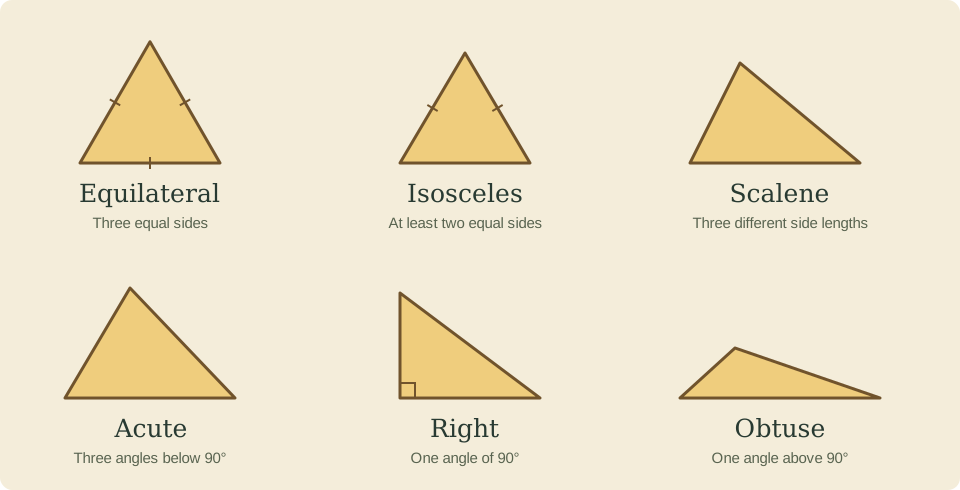
The first had three equal sides.
“Equilateral,” said Gidget. “All three side lengths are equal.”
Leo turned it upside down.
“Still equilateral?”
“Still equilateral.”
The second had two equal sides and a shorter third side.
“Isosceles,” said Gidget. “At least two sides are equal.”
“At least?” Leo asked.
“With that definition, an equilateral triangle is a special isosceles triangle, too. Some schoolbooks use the word only for exactly two equal sides.”
Leo nodded. Families could fit inside bigger families. Pip was a cat and an explorer, after all.
The third frame had three different side lengths.
“Scalene,” said Gidget.
Leo tried the names aloud. “Equilateral. Isosceles. Scalene.”
Pip said, “Mrrp.”
“A shorter name,” Gidget admitted, “but less useful for sorting.”
4. The corner families
Another wall glowed.
“This time,” Gidget said, “look at the angles: how wide the corners open.”
He held up a card with a square corner.
“This is a right angle. Ninety degrees.”
One triangle had three corners narrower than the card’s corner.
“Acute,” said Gidget. “All three angles are less than ninety degrees.”
The next had one corner that fitted the card exactly.
“Right triangle. One angle is ninety degrees.”
The last had one corner opened wider.
“Obtuse. One angle is greater than ninety degrees.”
“Could a triangle have two right angles?” Leo asked.
Gidget gave him a paper triangle. Leo tore off its three corners and placed their points together, side by side. The angles made a straight line.
“One hundred and eighty degrees,” Gidget said. “That is the angle total for a triangle drawn on a flat surface.”
“Two ninety-degree corners would use all of it,” Leo said. “Nothing left for the third!”
He found a triangle with two equal sides and a right angle.
“Isosceles AND right!”
The hall rang like a cupboard full of tiny bells.
5. Why the little bridge stayed still
At the end of the hall, a toy bridge crossed a ribbon of blue light.
Gidget showed Leo a square frame made of four rigid bars joined by loose hinges.
Leo pushed a corner gently. The square leaned sideways into a slanting shape.
“The bars haven’t changed length,” he said. “But the frame has changed shape!”
Gidget added a diagonal brace, dividing the square into two triangles. Leo pushed again.
This time, the frame held its shape.
“Three fixed side lengths determine a triangle’s shape,” said Gidget. “It cannot lean into a different shape unless something bends, stretches, or comes apart.”
“So that is why we see triangle braces in bridges and roofs.”
Pip tested the toy bridge with one cautious paw.
“Approved by our chief bridge inspector,” said Leo.
6. The tree nobody needed to climb
The doorway opened onto a sunny meadow. A tall tree stood beside the path.
“How tall?” Leo wondered. “Our tape won’t reach the top.”
“Let us measure something we can reach,” said Gidget.
On level ground, he stood a one-metre measuring pole upright. Its shadow was two metres long. At the same time, the tree’s shadow measured ten metres from the trunk to the shadow of its highest point.
Gidget drew two triangles in Leo’s notebook.
For each, an upright object made one side. The ground shadow made another. An imaginary line following a sunbeam from the object’s top to the shadow’s tip completed it.
“The pole and tree are vertical,” he said. “The ground is level. The sunlight reaches them at practically the same angle. So these triangles have matching angles.”
“One is a bigger version of the other!”
“Exactly. We call them similar triangles. Their matching lengths grow by the same multiplier.”
Leo compared the shadows.
“Ten is five times two. So the tree must be five times as tall as the one-metre pole.”
He wrote:
Shadow: 2 metres → 10 metres. Multiply by 5.
Height: 1 metre → 5 metres. Multiply by 5.
“About five metres tall!”
“About,” Gidget agreed. “Our answer depends on how carefully we measure.”
Pip’s shadow stretched across the notebook.
“You can be next,” Leo told him.
Pip moved. Apparently, cats did not always wish to be measured.
7. A triangle across the stream
Farther on, a stream blocked the way to a red marker on the opposite bank.
Leo kept back from the edge.
“We can see the marker,” he said, “but we cannot stretch our tape across.”
Gidget marked two safe spots on their side, A and B, and measured the straight distance between them. That measured side was their baseline.
He pointed from A to the distant marker, then from B to the same marker.
“Imagine three straight lines,” he said. “A to B. A to the marker. B to the marker.”
“A triangle! Two sides go across the water.”
Using an angle-measuring instrument, Gidget measured the angle between the baseline and the marker’s direction at each spot. Then he drew a careful scale drawing on paper.
The two drawn directions met at a little dot.
“We knew one side and the two angles beside it,” Gidget said. “That fixes the triangle’s size and shape. Now we can use the drawing’s scale to estimate the other distances.”
Leo measured from A to the dot on the paper.
“A small distance on the page can tell us a big distance outside.”
“This method is called triangulation. Surveyors have used it to map places they could not measure by walking every line.”
“Even without crossing the stream!”
Gidget nodded. Pip looked relieved. He had never agreed to the swimming part of this expedition.
8. What made the triangle so useful?
On their way home, Leo held his three sticks like a tiny treasure.
“I think I know why triangles are such useful measuring helpers,” he said.
“Tell us,” said Gidget.
“Their sides and angles belong together. If we know the right pieces, we can work out the missing ones.”
“Yes. The triangle itself is not a ruler. It gives us relationships that turn measurements we can make into distances we want to know.”
“A shadow instead of a treetop. Two directions instead of a wet crossing.”
“And sometimes a calculation instead of a very long tape.”
Leo looked at Pip’s ears, the roof above the door, and the corner of Gidget’s folded map.
Triangles everywhere.
He placed his sticks beside his notebook and wrote:
Three sides. Three corners. A way to reach with our minds.
Pip sat on the notebook.
“And one cat,” Leo added, “who has measured exactly where I wanted to write.”
Your triangle field guide
The core idea: A triangle is a closed, flat shape made of three straight line segments. It has three sides, three vertices, and three interior angles. On a flat surface, those angles add to 180°.
Sort by sides: Equilateral means three equal sides; isosceles means at least two equal sides in the inclusive definition used here; scalene means all three side lengths differ.
Sort by angles: Acute means all three angles are below 90°; right means one is exactly 90°; obtuse means one is above 90°. Each triangle has both a side description and an angle description. Equilateral triangles are always acute, with three 60° angles. Turning a triangle does not change its type.
Base and height: Any side may be chosen as the base. Its corresponding height is the perpendicular distance from the opposite vertex to the line containing that base. Perpendicular means meeting at a right angle. Height is not usually the sloping side; in an obtuse triangle, a height can fall outside the triangle.
Around and inside: Perimeter is the sum of the three side lengths. Area is half the base times its corresponding height. A base of 6 centimetres and a perpendicular height of 4 centimetres give an area of 12 square centimetres.
Why triangles help measure: Their predictable relationships let us infer unknown lengths from enough known information. A baseline and its two adjacent angles fix one triangle. Matching angles give similar triangles, whose corresponding sides are proportional. Three angles alone tell us shape, but not size: we need a known length to set the scale.
A little further: the right-angle shortcut
In a right triangle, the side opposite the right angle is the longest side: the hypotenuse. If the two shorter sides have lengths a and b, and the hypotenuse has length c, then a² + b² = c². This is the Pythagorean theorem. It applies to right triangles.
A flat rectangular garden measures 3 metres by 4 metres. Its corner-to-corner diagonal makes a right triangle with two garden edges. Since 3² + 4² = 9 + 16 = 25 = 5², that diagonal is 5 metres long.
For older explorers: trigonometry connects angles and side ratios. On level ground, if you stand a horizontal distance d from a tree and measure an upward angle θ to its top, its height is approximately d × tan(θ) + the instrument’s height above the ground. This assumes the tree’s base is at the same ground elevation as you. The added height matters: your measuring instrument is not at ground level.
Triangles are a foundation of surveying and height measurement, but they are not the only method. Modern instruments also measure distances directly using light or other signals.
Try it with Leo, Pip, and Gidget
- Draw a triangle on paper. Turn the paper around. Do its side lengths or angles change?
- Cut out a paper triangle. With a grown-up’s help if needed, tear off the three corners and arrange their points together to make a straight angle.
- Try making a closed triangle with strips 2, 3, and 6 centimetres long. Then try 3, 4, and 5 centimetres. Which set works? Why?
- On a sunny day, with a grown-up, measure an upright object's height and its shadow on level ground. Measure another object's shadow at the same time. Can you estimate its height? Stay away from roads and water, and never look directly at the Sun.
- Puzzle: a 1-metre pole has a 2-metre shadow. A vertical flagpole on the same level ground has an 8-metre shadow at the same time. About how tall is the flagpole?
Open Gidget’s answer notebook
Turning the paper does not change the triangle. Its three interior angles fit together into a straight angle of 180°. The 2, 3, 6 strips cannot close because 2 + 3 is less than 6; the 3, 4, 5 strips do form a triangle. For the flagpole puzzle, the shadow multiplier is 8 ÷ 2 = 4, so the height is approximately 1 × 4 = 4 metres.
A note for grown-up explorers
The glowing hall is imagined. The geometry is ordinary Euclidean geometry on flat surfaces; triangles drawn on a sphere need different angle rules. The supplied artwork is an illustration, not a precision drawing to measure or classify by eye. Some shapes are solid objects with triangular faces; a triangle is a flat shape, while a pyramid is a solid.
The shadow example assumes upright objects, level ground, shadows from the highest points, and measurements at effectively the same time. Triangulation also depends on accurate angles, a measured baseline, and a suitable layout. These are useful estimates and mathematical models, not promises that every outdoor measurement will be exact.
Some textbooks define isosceles as exactly two equal sides. This story uses the inclusive “at least two” definition and explains the difference so a child’s classroom wording can be respected.
Explore further: OpenStax: triangle types, similarity, and applications · OpenStax: angles and the Pythagorean theorem · NOAA: triangulation in surveying · Penn State: baselines, angles, and mapping · Wolfram MathWorld: the inclusive isosceles definition