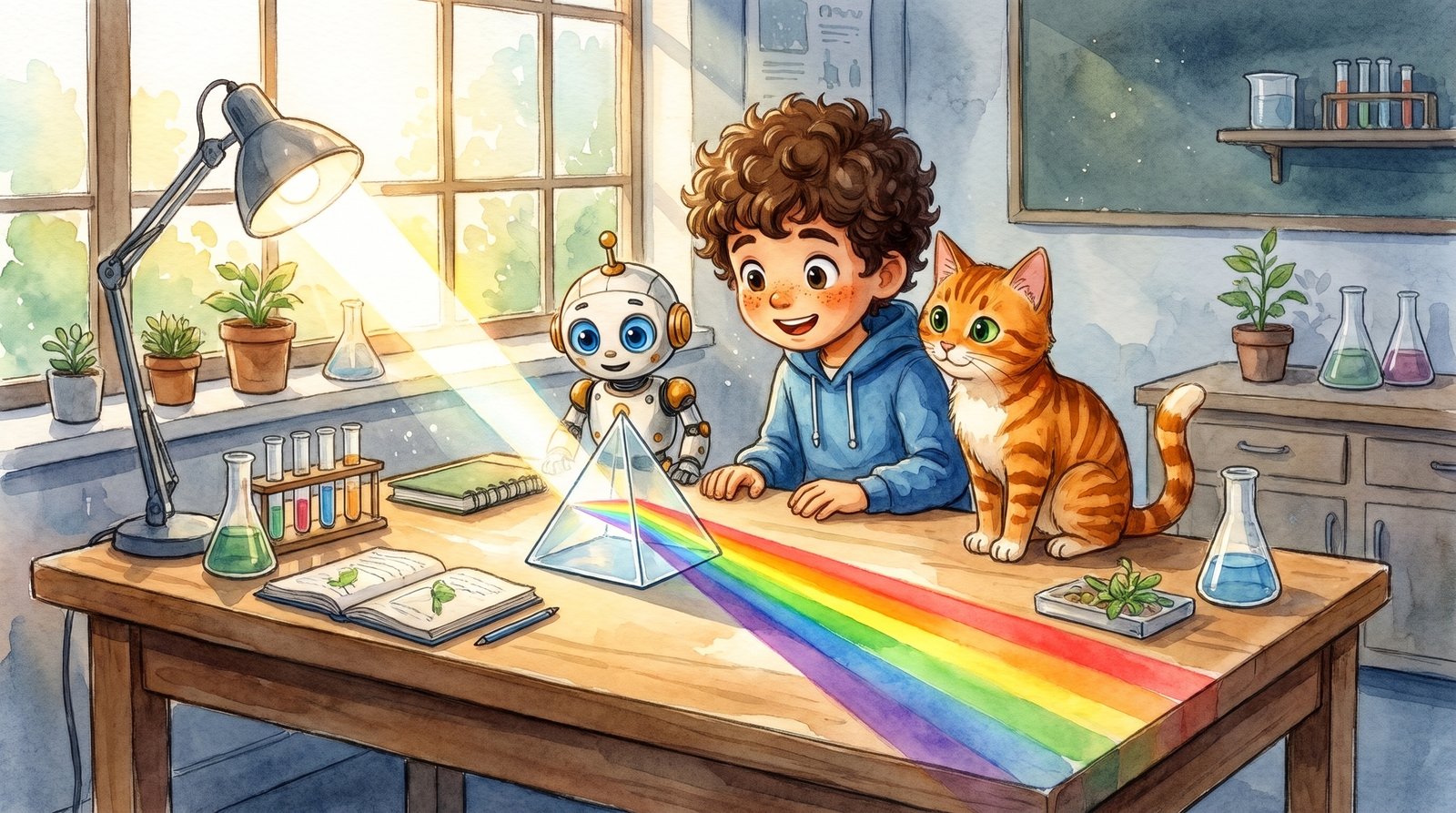
A workshop full of wonder. The illustration imagines the discovery; the crystal and bright light paths are not an exact scientific diagram.
1. A sea across the table
Pip was sitting beside Leo’s notebook when a stripe of red appeared near his paws.
Beside it came orange. Then yellow, green, blue, and violet.
A little sea of colour stretched across the white paper on the table.
Pip lifted one paw very carefully.
“You won’t get wet,” Leo told him. “I think.”
Gidget stood by the window, holding a clear glass prism in a narrow patch of afternoon sunlight.
Leo looked at the prism. He could see right through it.
“Where were you keeping all those colours?”
“I wasn’t,” said Gidget. “They arrived with the light.”
Leo inspected the glass for a hidden compartment.
Pip inspected the table for fish.
Neither found anything.
2. The visitor from a star
Gidget moved the prism aside. The coloured band vanished, leaving a bright patch of sunshine.
“That light came from the Sun,” he said. “It travelled through space for about eight minutes before reaching Earth.”
Leo looked at the bright paper, keeping his eyes away from the Sun itself.
“Eight minutes ago, it was still out there?”
“Near the Sun, yes.”
Leo imagined a tiny traveller crossing the enormous dark between a star and their window, arriving just in time to land beside Pip’s paw.
Gidget switched on the desk lamp.
“This makes light here in the room, using electricity. The Sun gives out light of its own, too. Its hot, glowing surface sends us a mixture of many wavelengths.”
“What are wavelengths?”
“Let me show you a picture.”
3. The light we cannot see waving
Gidget drew two wavy lines in Leo’s notebook.
One had its humps close together. The other had them farther apart.
“Light behaves as a wave. Wavelength tells us how far it is from one wave crest to the next. Visible red light has longer wavelengths than visible violet light.”
Leo ran a finger along the drawings.
“Are there little waves wobbling across the table?”
“Far too small and fast for us to watch like waves in a pond. These drawings are only a model.”
“And sunshine has lots of wavelengths together?”
“Exactly. When that mixture reaches our eyes together, it can look white.”
Leo looked at the plain bright patch.
It suddenly seemed rather crowded.
4. The glass that opened the crowd
Gidget returned the prism to the sunbeam and slowly turned it.
The colours spread across the paper again.
“Light travels differently through glass than through air,” he explained. “When it crosses into the glass at an angle, its direction changes. That bending is called refraction.”
“Like turning a corner?”
“A little. And it bends again when it comes out.”
Gidget pointed to the red edge, then the violet.
“Different wavelengths travel at slightly different speeds in this glass, so they bend by different amounts. Violet bends more than red. The prism’s angled faces spread them into different directions.”
Leo imagined a crowd arriving together, then taking slightly different paths through a glass doorway.
The red path went one way. The violet turned farther. Between them were all the other colours.
“That spreading is called dispersion,” Gidget said. “The band we see is a spectrum.”
Leo examined the yellow as closely as he could without blocking the beam.
“Where does yellow stop and green begin?”
“They blend gradually. The names help us talk about them, but sunlight’s spectrum has no little fences.”
Pip put a paw into the blue.
For a moment, he looked dressed for an underwater expedition.
5. Putting the sea away
“Could the colours come together again?” Leo asked.
Gidget brought out a second prism. He carefully arranged it so that the separated light overlapped again on another white card.
A pale patch of almost-white light appeared.
Leo glanced from one card to the other.
“Spread apart. Brought together.”
“The first prism didn’t make new colours,” Gidget said. “It separated light that was already in the mixture.”
Leo held his notebook over the incoming sunbeam.
The whole spectrum disappeared.
He lifted it.
Back came the sea.
“And without the light,” he said, “there’s nothing to spread.”
Pip settled on the notebook. This made the experiment more difficult, but considerably cosier.
6. A workshop made of rain
Later, a shower pattered across the garden.
They watched from the doorway until it passed. Then sunshine slipped beneath the edge of the departing cloud.
Gidget led them outside, with the Sun behind their backs and rain still falling in the distance.
Across the sky stood a rainbow.
Leo stopped so suddenly that Pip bumped into his shoe.
“The table!” Leo whispered. “It’s doing the table!”
“A related light trick,” said Gidget. “This time, the clear things are drops of water.”
He drew one round drop in the notebook.
“Sunlight bends as it enters. Some of it reflects from the inside at the back of the drop. Then it bends again as it comes out. The different wavelengths emerge in different directions.”
“Bend, bounce, bend,” Leo murmured.
He imagined a tiny glass workshop inside each raindrop. There were no robots in them, of course. Water and light could do this without instructions.
“Does one drop send us the whole rainbow?”
“The colours reaching your eyes come from different drops. Many, many drops together make the rainbow you see.”
7. Why the sky makes a bow
Leo traced the rainbow in the air.
“Why a curve? Our table had a stripe.”
“The drops are round, and they send the strongest rainbow light back at particular angles. The drops in the right directions for your eyes make a circular pattern.”
“A whole circle?”
“Yes. From the ground, we usually see only part of it: a bow. From high above the ground, people can sometimes see the whole circle.”
Leo took a few steps along the path.
“Can I get underneath it?”
“As you move, different drops send rainbow light to your eyes. It isn’t a coloured bridge waiting in one fixed place.”
Leo stood still again.
There was red along the outside of the bow, violet towards the inside, and more shades between them than he knew how to name.
Pip watched a leaf drip.
The rainbow faded as the rain moved away.
For a moment, Leo felt disappointed.
Then he remembered the prism waiting on the table.
“It hasn’t used up the colours,” he said.
“No,” said Gidget.
Leo opened his notebook and wrote:
A star sent the light. A raindrop changed its path. My eyes found a rainbow.
Below it, he drew a very small cat sailing across a very large sea of colour.
That part was entirely his own idea.
Try a little light discovery
With an adult, use a purpose-made educational prism and a narrow patch of sunlight to make a spectrum on white paper. Slowly turn the prism and move the paper until colours appear; a broad beam can make them overlap and look washed out. Watch the paper, never the Sun or a bright beam through the prism. Do not use a laser. Put the prism away after the activity rather than leaving it in direct sunlight.
Can you find a place where one named colour gradually becomes another? Draw what you actually see, including any faint or missing-looking parts.
A notebook for curious readers and grown-ups
Source and journey. The Sun emits its own light, while a lamp converts electrical energy into light. Sunlight takes about eight minutes to reach Earth from the Sun. The tiny traveller is Leo’s imagined way of picturing that journey. NASA: Earth facts
Refraction and dispersion. At an oblique boundary between air and glass, light changes direction because its propagation speed changes. Ordinary prism glass has a refractive index that varies with wavelength, so violet is deviated more than red. The wave sketch and doorway crowd are models, not things travelling inside the glass. OpenStax: dispersion
A spectrum has many shades. The familiar six or seven colour names label parts of a continuous visible spectrum, not separate compartments. Carefully aligned optics can recombine the dispersed light. Different lamps have different spectra; a white-looking lamp need not reproduce sunlight’s spectrum. OpenStax: spectroscopy
Inside a raindrop. The ordinary primary rainbow involves refraction on entry, one internal reflection of some light, and refraction on exit. This internal reflection is partial, not total. The strongest red primary-bow light is seen about 42 degrees from the direction opposite the Sun; violet is closer to that direction. National Weather Service: how rainbows form
A rainbow needs a viewer. Different sets of droplets supply different colours to the observer. Moving changes which droplets contribute; a rainbow has no fixed, reachable end. The primary bow is red outside and violet inside. A complete circle can be visible from a suitable elevated viewpoint. Hong Kong Observatory: rainbows, NOAA/NASA: what causes a rainbow
About the picture. The supplied artwork shows a pyramid-shaped crystal and broad, brightly visible beams. The story’s demonstration uses an ordinary triangular prism. Clean air does not usually reveal a bright sideways view of a light beam; dust or mist can scatter some light towards us. Beam widths, bending angles, and colour bands in the illustration are artistic, not measured. Gidget’s conversation and Leo’s travellers, doorways, and raindrop workshops are fiction around real optical processes.