1. A pocketful of red
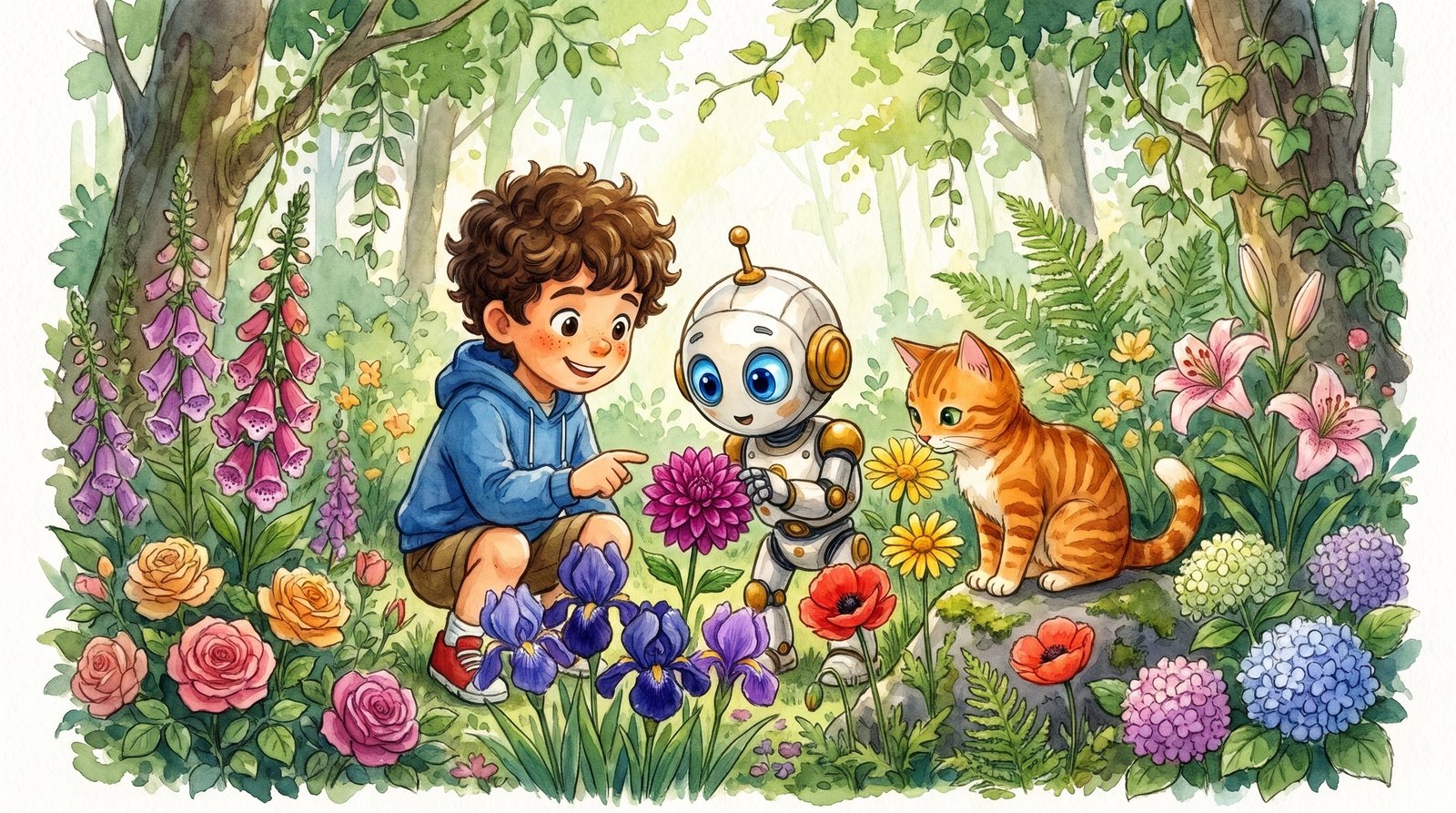
Leo crouched beside a red poppy.
“How does a flower make a colour?” he asked. “Does it drink red from the ground?”
Pip sniffed a yellow flower. His nose came away exactly the same colour it had been before.
“Plants make substances called pigments,” said Gidget. “They are inside the flower’s cells—tiny parts that make up its petals.”
“Like little pockets of paint?”
“A little. But the plant makes its pigments as it grows. Nobody goes around painting the petals.”
Leo imagined a beetle carrying a paintbrush. It would have been a very busy beetle.
“Different pigments help flowers have different colours,” Gidget continued. “Some help make yellows and oranges. Others help make reds, purples, and blues.”
Leo studied the poppy.
“Then its red is safely inside.”
Gidget’s antenna gave a small, thoughtful blink.
“Shall we try something?”
2. The disappearing flower
On the path lay a fallen red petal.
Leo placed it inside Gidget’s little specimen box. The robot closed the lid, leaving a viewing hole that Leo could shade with his hands.
Inside was darkness.
“I can’t see the red!” Leo said.
He lifted the lid.
There it was.
He closed it.
Gone again.
Pip peered into the hole, then inspected the back of the box. He appeared to suspect a second petal.
“Did the pigment switch off?” Leo asked.
“The pigment is still there. But we need light to see the petal.”
Leo opened the box once more. Sunlight slipped across the red surface.
“So the flower needs a visitor.”
“Light,” said Gidget.
3. What the petal sends back
Gidget held a small glass prism above a white page. A patch of sunlight spread into a band of colours.
Leo leaned close.
“Those were all in the sunlight?”
“Yes. Sunlight contains a mixture of light. The prism separates it into colours we can see.”
Across the paper lay red, orange, yellow, green, blue, and violet, flowing into one another without fences.
“When light reaches a petal,” Gidget said, “pigments absorb some parts of that mixture more strongly than others. Some of the light comes back out of the petal and travels towards us.”
“What about our red one?”
“In sunlight, it sends back a mixture richer in the light we see as red.”
Leo imagined sunlight arriving with a basket full of bright ribbons. Some stayed behind in the petal; others streamed out into the garden.
“The ribbons are only a picture in my head,” he said.
“A useful picture,” said Gidget. “Real light doesn’t carry ribbons.”
Pip tried to sit on the rainbow.
It coloured his paw instead.
4. The last part of the journey
Leo held the petal near his cheek.
“The light comes back from the flower. Then what?”
Gidget drew an eye in the earth with a twig.
“Some enters your eyes. Inside each eye, at the back, is a light-sensitive layer called the retina.”
He added a tiny patch of dots.
“It has cells called cones that help you see colour. Most people have three kinds. They respond differently to the light coming in.”
“Three kinds can see all these flowers?”
“They work together. Your eyes send signals to your brain, and your brain uses those patterns of signals to build what you see.”
Leo looked from the drawing to the poppy.
Sunlight. Petal. Eyes. Brain.
He traced the journey with his finger.
“All that happens when I look?”
“Before you can finish saying ‘red’.”
Leo said it very slowly, just to give the journey plenty of time.
“Rrrrrred.”
5. A garden after sunset
They stayed until the shadows stretched across the path.
The flowers grew harder to tell apart. The bright red poppy became a dim shape among the leaves.
“The pigments haven’t gone,” Leo said.
“No,” said Gidget. “There is much less light. In very dim light, other cells in your eyes, called rods, do more of the work. They help you see, but don’t give you the colour vision that cones do.”
Leo switched on his white torch and pointed it at the flowers.
Red. Yellow. Purple.
The garden’s colours appeared again in the little pool of light.
Pip stepped into it, orange from ears to tail.
“You too,” Leo told him.
6. The colour that arrived
On the way home, Leo carried the fallen petal in the open box.
“I thought colour was something a flower did all by itself.”
“Its pigments are part of the story,” said Gidget. “So is the light. So are the eyes looking at it.”
Leo glanced back at the darkening garden.
Tomorrow, sunlight would reach the petals again. Some of that light would reach his eyes. And there, without a sound, the whole bright garden would appear.
He imagined a tiny invitation travelling from the poppy:
There is something here to see.
Flowers could not write invitations, of course.
But Leo decided he would come back anyway.
A small discovery to try
Place a coloured toy or a fallen petal on white paper. Look at it in daylight, then in a shaded corner, then under an ordinary white lamp. What changes? What stays similar? Keep the light on the object, and never look directly at the Sun.
For curious readers and grown-ups
- Pigments absorb some wavelengths of light more strongly than others. Petal structure also affects how light is reflected, scattered, and transmitted. The ribbon basket is an imagined model of selective absorption, not a literal picture of light. Flower optics research
- Flower pigments include carotenoids, which contribute many yellows and oranges, and anthocyanins, which contribute many reds, purples, and blues. Pigment combinations and conditions inside cells also matter; there is no single pigment recipe for every colour. Floral pigment review
- Seeing colour involves overlapping responses from cone cells and processing in the retina and brain. Each cone type responds to a range of wavelengths, rather than detecting just one colour. People’s colour vision varies. National Eye Institute
The science is real; Gidget’s equipment, the dialogue, and Leo’s ribbon-and-invitation imaginings belong to the story. The illustration is an imaginative garden scene, not a botanical diagram.