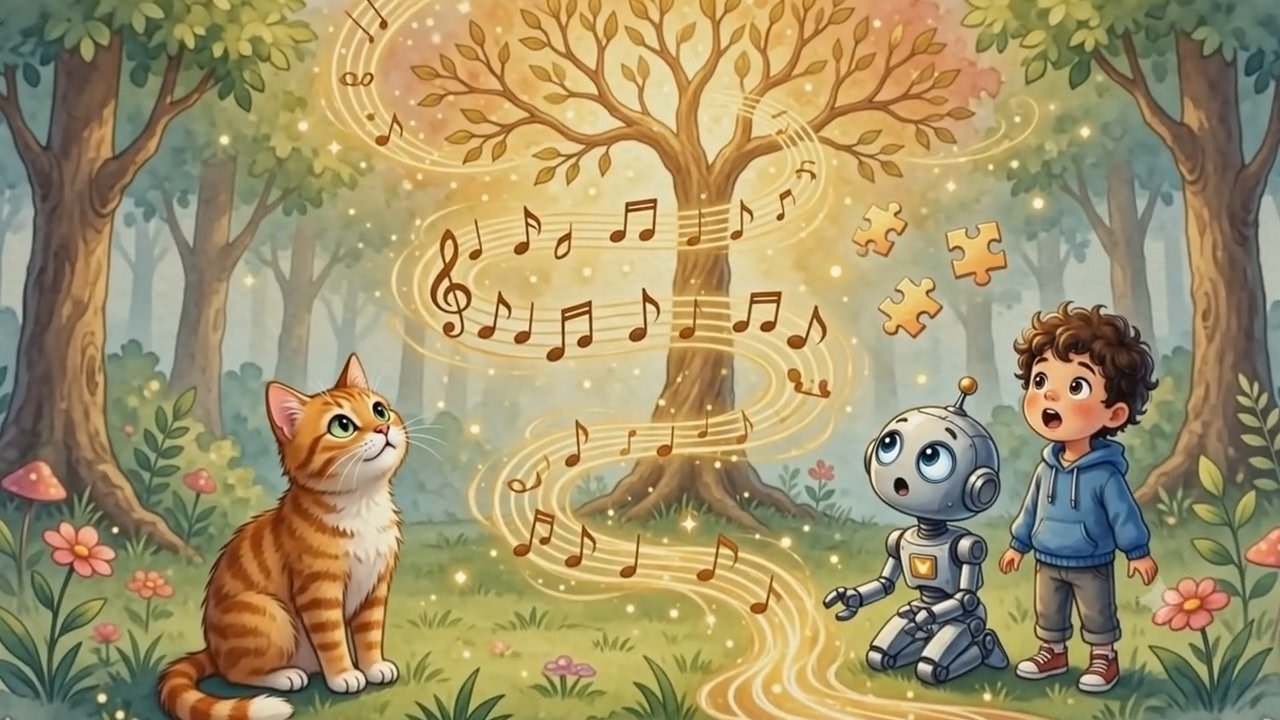
The glowing notes are our picture of a musical adventure. Real sound travels through the air as invisible changes in pressure.
1. A song without a singer
Leo stopped beneath a tree.
“Did you hear that?”
Pip’s ears turned. Gidget tilted his head.
Somewhere among the leaves came a soft, bright hum.
“Perhaps the tree has swallowed a flute,” Leo whispered.
A golden ribbon curled around the trunk. Little notes floated above it like fireflies.
Pip tried to catch one. His paw passed straight through.
“An imaginary music tree,” said Gidget. “A fine place for a real question.”
Leo listened again.
“What has to happen for us to hear anything at all?”
2. The tiny shiver
Gidget opened his explorer bag and took out a small string instrument.
Leo plucked a string.
Twang!
The string trembled so quickly that its middle looked blurry.
“It moves back and forth,” Leo said.
“That repeated movement is a vibration,” said Gidget.
Leo touched the string gently. The trembling stopped. So did the note.
“The moving string starts other things moving,” Gidget explained. “The instrument’s body vibrates, too, and disturbs the air around it.”
“Does a little parcel of air fly all the way into my ear?”
“The air mostly jiggles back and forth nearby. It passes the disturbance to neighbouring air, which passes it on again.”
Leo imagined a message travelling along a line of friends without everyone running to the end.
“The message travels!”
“So does energy. The changing air pressure reaches your eardrum and makes it vibrate. Your ear and brain turn that into hearing.”
Pip purred against Leo’s hand.
Another small vibration. This one came with whiskers.
3. High is not the same as loud
Gidget played a low note, then a higher one.
“The higher note has a faster repeating vibration pattern,” he said. “How often something vibrates is called its frequency.”
“And if I pluck harder, will the note climb higher?”
“Try gently, then a little more firmly.”
Leo listened. The second note was louder, but it stayed nearly the same note.
“Bigger movements,” said Gidget, “usually make a louder sound. Faster repetitions usually make a higher pitch. Those are different changes.”
Leo raised one hand high and whispered, “High.” Then he lowered it and said, “Low.”
Pip watched the hand, expecting a biscuit.
“Also,” Gidget added, “we cannot hear every vibration. Some are too slow or too fast for human ears. Some are too faint.”
Leo put his ear near the tree, without pressing it against the bark.
The hum was quiet, but it was there.
4. The secret of the swing
A little swing hung from a branch in the imaginary clearing.
Leo sat down. Gidget gave him a small, gentle push.
Forward. Back. Forward. Back.
“Again!” said Leo.
Gidget waited until the right moment, then gave another small push in the direction Leo was moving.
The swing travelled a little farther.
“You didn’t push very hard.”
“I pushed at the right time.”
Gidget gave several gentle pushes, each keeping time with the swing’s motion.
“A swing has a natural pace,” he said. “When repeated pushes match that pace, they can keep adding energy to its motion. That is a way to understand resonance.”
“Little pushes that arrive when they can help!”
“Exactly. A push at the wrong time can do much less—or even slow you down.”
When the pushes stopped, the swing gradually slowed.
“The movement loses energy to its surroundings,” Gidget said. “Resonance does not make energy out of nothing.”
Pip sat on the ground. He preferred a seat that stayed where he left it.
5. The fork that answered
At the tree’s roots stood two tuning forks on wooden sound boxes. They were matching musical tools, each with two metal prongs.
Gidget gently struck the first with a soft mallet.
Hummmmm.
The second fork had not been touched.
Yet when Gidget stopped the first fork, a faint hum remained.
Leo leaned forward.
“The other one is answering!”
“Its natural vibration rate matches the first fork’s,” said Gidget. “The arriving sound gives it many tiny pushes at a helpful pace. Its vibration can build up enough for us to hear.”
“Like the swing, but much faster.”
“Yes. This is resonance through sound.”
Leo imagined the air carrying a careful invitation: now, now, now.
“The forks don’t really listen or decide to answer,” Gidget added. “Their materials and shapes make them respond this way.”
Pip touched his nose to the outside of one box, then withdrew it with dignity.
His nose had discovered enough physics for the moment.
6. Two little journeys inside one
Above them, the golden tree unfolded three ribbons of light.
“Let us slow an idea down so we can see it,” said Gidget.
On the first ribbon, a glowing dot made one complete journey out and back.
During that very same time, a dot on the second ribbon made two complete journeys.
On the third, another made three.
Leo followed them with his finger.
“The first takes its time. The next fits two journeys into the same space of time. The last fits three.”
“That is the feeling of twice as often, or three times as often,” Gidget said. “You do not have to count hundreds of vibrations to imagine the relationship.”
“Can we clap it?”
Gidget tapped a slow, steady beat. Leo fitted two evenly spaced light taps into the time between one Gidget tap and the next.
“Our tapping is a slow model,” said Gidget. “It is rhythm. A pitched note needs much faster repeating vibrations.”
Then Gidget played two gentle notes: one, then another whose vibration frequency was twice as high.
The second sounded higher, yet somehow familiar.
“Like a little upstairs room in the same house,” Leo said.
“Musicians call that distance an octave.”
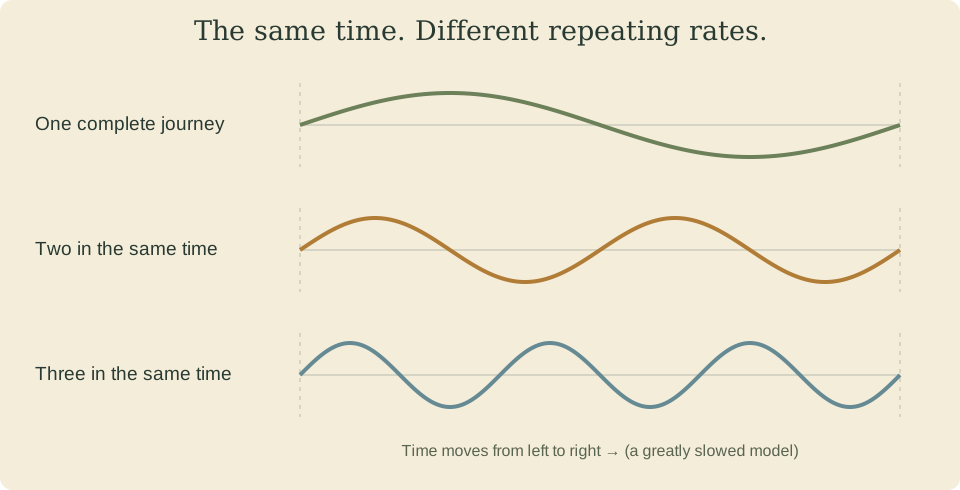
The same amount of time in each row. The curves show a repeating movement over time, greatly slowed for imagination; actual pitched sounds vibrate far faster.
7. A family inside a note
Leo plucked the string again.
“Is that just one vibration?”
“A string can have several vibration patterns at once,” said Gidget. “Imagine a big back-and-forth pattern, with smaller, faster patterns mixed into it.”
The tree’s ribbons curled together.
“In an ideal string, some of these faster patterns repeat twice, three times, four times as often as its slowest pattern. These are called harmonics. The slowest is the fundamental—and it is the first harmonic.”
Leo pictured several little journeys tucked inside the time of a larger one.
“So a note can carry a family of sounds together?”
“Yes. Their mixture helps give an instrument its sound colour, or timbre. That is part of why a flute and a violin can play the same note and still sound different.”
“And resonance?”
“That is the helpful response to repeated pushes near a natural vibration rate. Harmonics describe related vibration frequencies. The ideas meet in instruments, but they are different ideas.”
Leo nodded. He did not need to hold every word at once.
For now, he held a picture: a slow journey, two quicker journeys, three quicker journeys—and a string carrying more than one pattern.
8. What turns sounds into music?
Pip brushed a dry leaf.
Scritch.
Leo tapped the instrument’s wooden side softly.
Tok. Tok. Pause. Tok.
Gidget answered with a little tune.
Leo hummed along. Pip purred whenever he pleased.
“Not all of those sounds have a clear note,” Leo said. “But together, we’re making something.”
“Music can use steady pitches, rustles, drumbeats, pauses, and surprises,” said Gidget. “People shape and listen to sounds in patterns that can carry feelings and meaning.”
“Does every note have to fit the tidy family?”
“No. Drums and bells can have different vibration relationships. Music is much bigger than one pattern.”
The golden notes began to fade. The ordinary tree stood quietly in the evening light.
Leo listened to the leaves, a distant bird, and the soft scuff of his shoes.
“The world is full of movements I cannot see,” he said.
“And some,” said Gidget, “you can hear.”
Pip purred.
Leo rested his hand against the warm, furry vibration.
That was his favourite note of the day.
Take a little idea home
Vibration: Repeated movement back and forth. Vibrating objects can start sound waves in the surrounding air.
Frequency and pitch: Frequency describes how often a vibration repeats. Faster repetition generally gives a higher pitch. Pitch is how high or low a sound seems; loudness is how loud or soft it seems. They are different.
Resonance: Repeated pushes near a system’s natural vibration rate can transfer energy especially effectively and make its motion larger. Think of well-timed pushes on a swing. Resonance needs an energy source; it does not create energy.
An octave: A note with twice another note’s frequency is one octave higher. Imagine fitting two complete vibration cycles into the time of one. This is an intuition about relative rates, not a demand to do sums.
Harmonics and sound colour: Harmonics have frequencies that are whole-number multiples of a fundamental: one, two, three, and more times its rate. Many musical tones contain several together. Their relative strengths help shape timbre, along with how a sound begins, changes, and fades. Not every instrument’s partials—the component vibrations in its sound—are exact harmonics.
Try a gentle listening adventure
- Hum softly and rest your fingertips lightly on the front of your throat. Can you feel a vibration? Stop humming. What changes? Do not press.
- Tap a quiet, steady beat on your knees. Invite someone to fit two evenly spaced taps into the time between each of yours. Swap roles. This models relative rates slowly; it is not a model of sound travelling through air.
- With a grown-up, hold a ruler firmly on a table with a short part extending over the edge. Gently pluck the free end. Try a different overhang, keeping your grip similar. Which tends to sound higher? Keep faces away from the moving end.
- Listen to one quiet sound. Is it high or low, loud or soft, smooth or scratchy? Can you describe it without deciding whether it is “good” or “bad”?
Open Gidget’s listening notebook
Your vocal folds vibrate when you hum. Two taps in the time of one help you feel a faster repetition rate without using big numbers. A shorter free length of the same ruler, held in a similar way, generally vibrates faster and sounds higher. None of these activities needs loud sound. Stop if a sound feels uncomfortable.
A note for grown-up explorers
The musical tree, visible notes, and light ribbons are imagined. The vibration, sound transmission, octave relationship, and resonance examples are physical ideas. Air sound waves are mainly longitudinal pressure disturbances: air particles move back and forth locally rather than travelling from instrument to listener. Sound also travels through liquids and solids; it cannot travel through a vacuum.
The tuning-fork demonstration assumes suitably matched forks on resonant boxes, close enough and in a quiet enough setting for sympathetic vibration to be audible. Resonance is a frequency-dependent response with damping; everyday objects can have several natural modes, and a match does not guarantee a large or easily heard response. A guitar body helps couple string energy into the air; that is not the same as amplifying every frequency equally.
The ideal stretched string’s harmonic relationships are a useful starting point, not a law for every instrument. Bells and drums may have inharmonic partials. An octave concerns frequency, not doubling loudness, doubling a sound wave’s travel speed, or making two identical instruments play together. Two identical notes together do not automatically become a note an octave higher.
This story offers a first intuition: “more complete repetitions in the same time.” Formal frequency units and multiplication can come later. Enjoying music does not require calculating it, and musical taste is not decided by simple ratios alone.
Explore further: University of Southampton: harmonics and hearing · UC San Diego: harmonics, pitch, and timbre · OpenStax physics lab manual: resonance and tuning forks