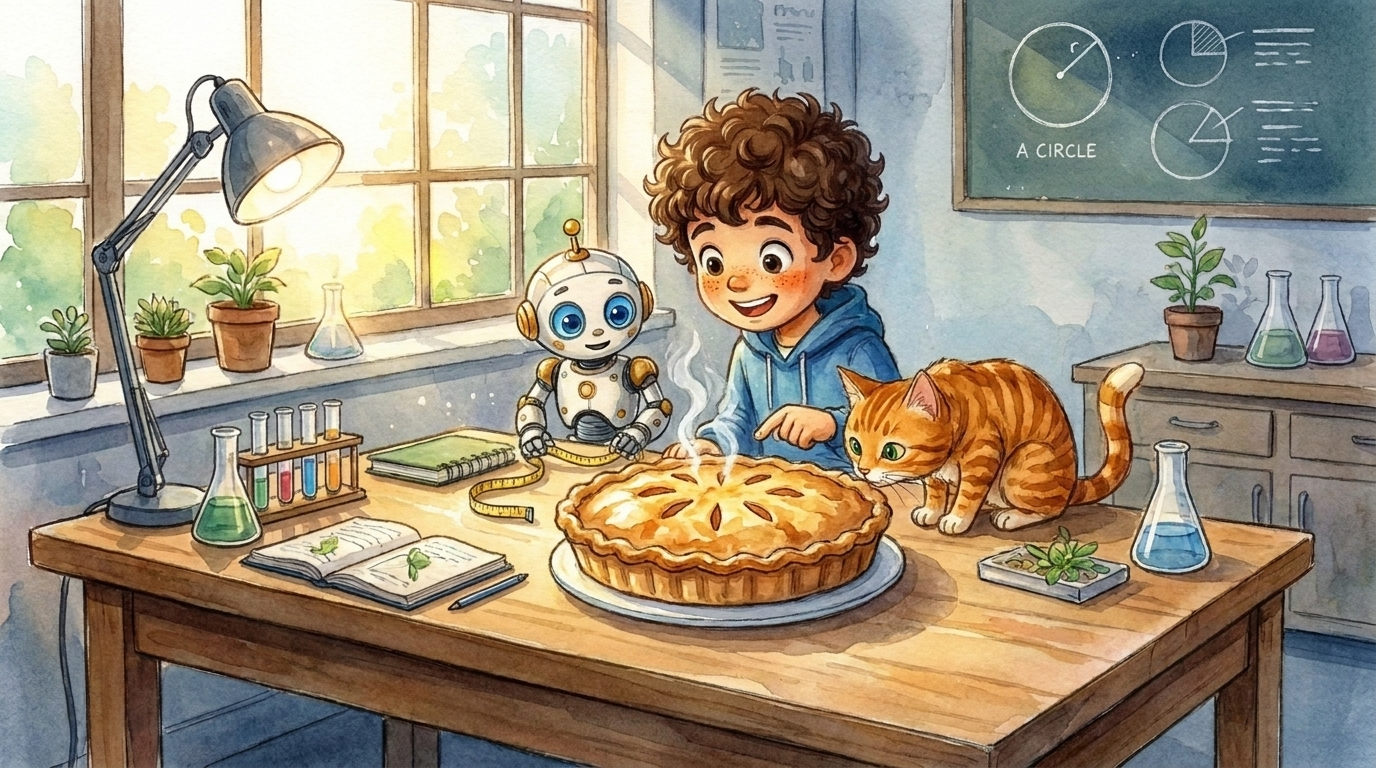
An afternoon discovery with the explorer trio. The illustration is a story scene; use the labelled circle guide below for the mathematics. Keep real food and measuring activities away from laboratory materials.
1. A question before a slice
The workshop smelled of warm apples and cinnamon.
An apple pie stood on its own clean tray, far from Gidget’s experiments. Its golden crust rose in little hills. Steam curled through the slits like tiny clouds leaving a delicious planet.
Leo pulled up a chair.
Pip pulled up his nose.
Gidget pulled out a notebook.
“We’re waiting for it to cool,” Leo told Pip.
Pip sat down with the expression of a cat who had never agreed to waiting.
Leo looked at the round pie tin. Then at the round plate beside it.
“How much farther is it around the edge than straight across?”
Gidget’s little antenna tilted.
“That,” he said, “is an excellent question to ask before a slice.”
2. Two journeys around a circle
They left the hot tin alone. Gidget brought a cool, round lid to the clear end of the table.
“Let’s practise here.”
He traced a route around its rim.
“Once all the way around. That distance is called the circumference.”
“The long way home,” said Leo.
Then Gidget laid a ruler straight across the lid, from one edge to the other, through its centre.
“This distance is the diameter. It must go through the middle.”
Leo tried a line closer to the edge. It was shorter.
“So any line across won’t do.”
“Exactly. Through the centre.”
Pip stretched across the sunny patch on the table. His tail curled around a notebook.
“Pip is demonstrating both journeys,” Leo said. “Rather untidily.”
3. The string that went the long way
Gidget wrapped a piece of string once around the lid’s circular rim. Leo marked where the end met the beginning. They straightened the string beside the ruler without stretching it.
“About thirty-one and a half centimetres,” Leo read.
Across the centre, the lid measured ten centimetres.
Leo put his finger at ten on the ruler, then twenty, then thirty.
“The journey around is three journeys across—with a little extra!”
They tried again. This time the string sat more snugly against the rim.
“About thirty-one point four,” said Gidget.
“Did the lid shrink?”
“Our measuring improved. Loose string and tiny marks can change our reading.”
Leo wrote down both attempts. He did not rub the first one out.
It was part of the discovery too.
4. A small lid, a big surprise
“Perhaps it only works for this lid,” said Leo.
They found a smaller circular lid. Its diameter was about five centimetres; the distance around was about fifteen point seven.
Three journeys across, and a little extra again.
Then they measured a larger, cool plate: about twenty centimetres across and sixty-two point eight around.
Leo stared at the notebook.
“The bigger circle has bigger distances. But the around-distance still fits a little more than three across-distances!”
Gidget drew two circles, one small and one large.
“Imagine enlarging the small circle until it matches the big one. Every length grows by the same amount. Double its diameter and you double its circumference.”
“So their comparison stays the same.”
“Yes. Mathematicians call that comparison a ratio.”
Pip inspected the small lid, then the large plate.
He seemed more interested in what might eventually go on the plate.
5. Pie has a mathematical cousin
Gidget tapped a calculation into his little screen.
31.4 ÷ 10 = 3.14
“We divide the distance around by the distance across,” he said. “Our measurements give about three point one four.”
“Does that number have a name?”
“Pi.”
Leo turned towards the cooling apple pie.
“That pie?”
“Same sound. Different spelling.”
Gidget wrote pi, then the Greek letter π.
“This symbol stands for the exact ratio of circumference to diameter in a perfect circle. Every perfect circle has the same ratio.”
Leo drew a tiny pie beside the symbol.
“One you can eat,” he said. “One you can discover.”
Pip touched the tiny drawing with a paw.
Neither version appeared edible yet.
6. The little extra that would not end
“Is pi exactly three point one four?” Leo asked.
“That is a useful rounded value. Pi begins 3.14159265…”
“And then?”
“More digits. Its decimal digits continue forever without settling into a repeating block.”
Leo considered the string stretched across the table.
“Does that mean the journey around the lid never ends?”
“The journey ends as soon as you get back to where you started. The circumference is a finite distance. It’s the decimal way of writing pi that never finishes.”
“A small journey can have a very long number.”
“An endlessly long decimal,” said Gidget, “and a perfectly good place to stop walking.”
Leo wrote π in his notebook. Two little legs and a roof: a small symbol carrying more digits than the notebook could ever hold.
7. A ribbon for the pie
By now the tin was cool enough for a grown-up to move safely. Leo measured straight across its circular top rim: about twenty-four centimetres.
“Could we guess the around-distance before using string?”
Gidget nodded.
“Use three point one four for pi. Multiply the diameter by it.”
Together they calculated:
24 × 3.14 = 75.36
“About seventy-five point four centimetres around,” said Leo. “Nearly three ruler-lengths of twenty-four, plus a little more.”
They checked with string, following the same rim. Their answer was close.
“Not exactly the same,” Leo noticed.
“Our measurements are approximate, and a real tin isn’t a perfect mathematical circle. We also rounded pi.”
Leo looked from the tin to the notebook.
The number had helped him predict a journey he had not measured yet.
That felt rather like finding a secret path.
8. What remained after the pie
A grown-up cut Leo a slice.
Pip received his own usual cat treat, which he regarded as the most successful part of the experiment.
“The slice is a wedge,” Leo said. “Does pi belong to wedges too?”
“Pi helps with many questions about circles and parts of circles. Today we found it by comparing a whole circle’s circumference with its diameter.”
Leo looked around the workshop. The clock face. The round lid. A wheel on Gidget’s little trolley.
All those circles had been there before lunch.
Now each one seemed to be asking the same question.
He wrote one last line beneath the measurements:
A circle’s distance around is pi times its distance across the centre.
Then he added:
Apple pie is best shared. Pi is a discovery you can share without ever running out.
Pip purred. Gidget closed the notebook.
And Leo took the short journey from plate to mouth.
A little circle field guide
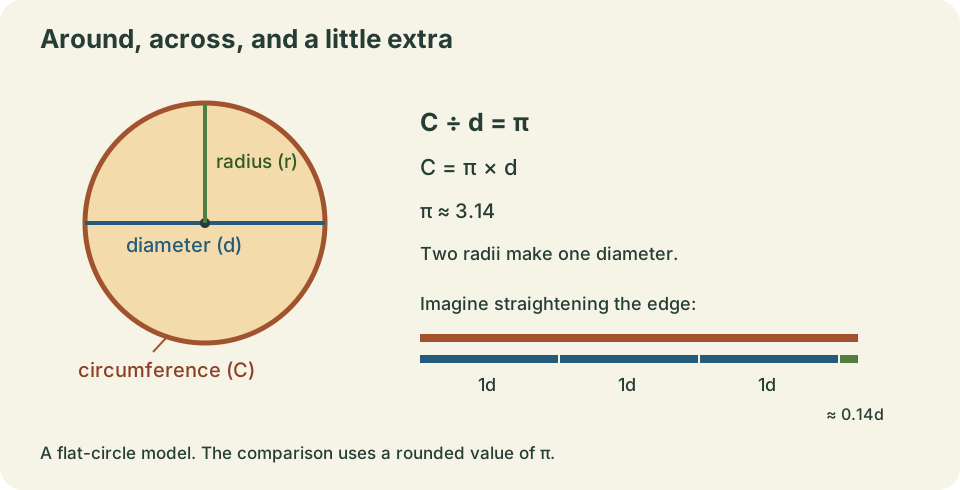
Circumference: the distance once around a circle. Diameter: the straight distance across it through the centre. Radius: the distance from the centre to the circle’s edge; two radii make one diameter.
The relationship: circumference ÷ diameter = π. You can also write circumference = π × diameter. Using 3.14 gives an approximate answer, not an exact one.
Try it: become a circle detective
- With a grown-up, collect two or three cool, unbreakable objects with circular rims, such as lids. Use a clear table away from food preparation or experiments. Keep string away from pets and small children; put it away afterwards.
- Measure straight across each rim through its centre. Record the diameter and its unit.
- Wrap string once around that same circular rim. Mark the meeting point, straighten it without stretching, and measure the circumference in the same unit.
- Compare: does the circumference fit three diameters, with a little left over? With help or a calculator, divide circumference by diameter.
- Compare the objects. Results close to 3.14 are expected; differences are clues to look for a loose string, a missed centre, rounded readings, or a rim that is not quite circular. Measurements suggest the pattern; they do not prove it for every circle.
Questions for curious explorers
- Why does the diameter have to pass through the centre?
- If a circle’s diameter doubles, what happens to its circumference?
- Why might two careful measurements give slightly different results?
- Is 3.14 exactly pi? Does pi’s endless decimal mean a circle has an endless circumference?
Open Gidget’s answer notebook
- A diameter connects opposite edges through the centre. An edge-to-edge segment that misses the centre is a shorter chord.
- Its circumference doubles too. Dividing circumference by diameter still gives π.
- String, ruler marks, positioning, rounding, and imperfect objects limit measurement accuracy.
- 3.14 is a rounded approximation. Pi’s decimal continues forever without a repeating block; any particular circle with a finite diameter has a finite circumference.
A note for grown-ups
This imagined afternoon introduces a mathematical constant through measurement and prediction. Gidget speaks as a fictional robot; Pip behaves as a curious cat. The supplied illustration is decorative, and its chalkboard marks are not teaching diagrams. Real food belongs away from laboratory equipment, and hot tins and cutting are grown-up jobs.
The listed measurements are illustrative, rounded readings, not recorded experimental data. Real lids and tins approximate circles. In ordinary flat-plane geometry, π is the exact common ratio C/d for circles; experiments give approximations and do not establish the general result. Pi is irrational: it cannot be written as a fraction of two integers, and its decimal expansion neither terminates nor becomes periodic. Children do not need that term to grasp the central relationship. No claim is made that the digits have been proved random or contain every possible sequence.
Optional next step: the radius is half the diameter, so C = 2πr. The area of a circular region is A = πr², measured in square units. Area measures the surface inside the boundary; circumference measures a length around it. These are different questions, and the story concentrates on length.
Educational references: Australian Mathematical Sciences Institute: the circumference of a circle and Math is Fun: Pi. They support the definitions, constant ratio, approximations, and measurement activity.