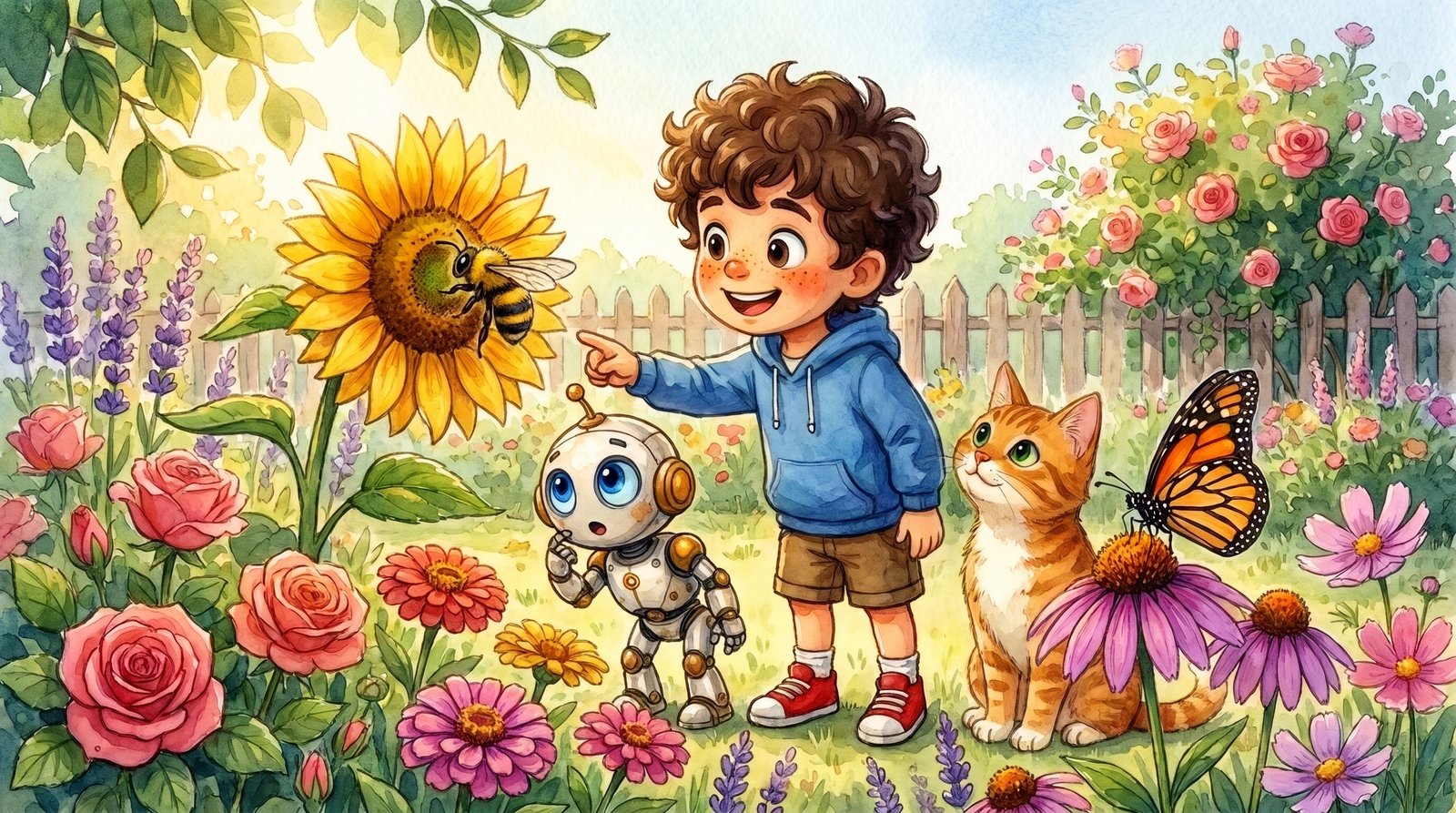
A garden full of connections. The illustration invites us to look closely; its friendly insects are not drawn to scientific scale.
1. A visitor with dusty trousers
Leo was about to bite into an apple when a bee landed on the sunflower.
He lowered his lunch.
“Look at its legs! It has dusty trousers.”
Pip lifted a paw toward a nearby butterfly.
“Let’s watch without touching,” Leo said softly, guiding his attention back to the path.
Gidget leaned forward, leaving the flowers plenty of space.
“That yellow dust is pollen. Bees gather some for food, and loose grains can stick to their bodies.”
“Did the sunflower spill it?”
“The centre of a sunflower is actually a crowd of tiny flowers. Look how the bee moves between them.”
Leo watched the little visitor bustle across the golden centre.
It looked as busy as a market on Saturday.
2. Why a flower has visitors
The bee flew to another bloom.
“Is it helping the garden on purpose?” Leo asked.
“It is looking for food,” said Gidget. “Many flowers provide nectar, a sugary liquid. Pollen is food for some visitors, too. As insects feed, they can carry pollen from one flower to another.”
“Like taking crumbs away on your jumper.”
Leo looked at his own jumper.
There were crumbs.
“A little like that,” Gidget said. “But pollen has a special part in making seeds.”
“Seeds! Like the bean we grew?”
“Yes. We followed a seed into a plant. Today we can follow a flower toward new seeds.”
Pip settled beside them. This sounded like an expedition that could be done sitting down.
3. The right landing place
On a low branch nearby, an apple blossom opened its pale petals.
Gidget showed Leo a drawing of a flower’s parts.
“These pollen-making tips are anthers. This receiving part is a stigma.”
“What does it receive?”
“Pollen. Moving pollen from an anther to a stigma is called pollination.”
Leo watched a bee visit the apple blossoms.
“So any flower dust can make any seed?”
“It needs to be suitable pollen from a compatible plant of the same species. Sunflower pollen will not turn an apple blossom into an apple.”
“The right kind, in the right place.”
“And the flower must be ready to receive it.”
Some plants could use their own pollen, Gidget explained. Others needed pollen from another compatible plant.
The garden was full of tiny journeys, but not every landing led to a seed.
4. A journey inside the flower
“Does a grain of pollen become the seed?” Leo asked.
“There is another step.”
Gidget turned a page in his drawing book.
When a suitable pollen grain landed on a receptive stigma, it could grow a very thin tube down into the flower. A sperm cell could travel through that tube to an egg cell inside an ovule.
“When those cells join, we call it fertilisation,” said Gidget. “That begins a new plant embryo. The ovule can develop into a seed around it.”
Leo thought for a moment.
“Pollination gets the pollen to the receiving place. Fertilisation happens afterward, inside.”
“Exactly.”
“Two different steps.”
Gidget nodded.
The bee went on feeding, unaware that it had helped with Leo’s lesson.
5. The apple’s old address
Leo looked at the apple in his hand.
“Was this once a flower?”
“It grew where an apple flower had been. Over time, parts of that flower developed into the fruit.”
With a grown-up’s help, they cut the apple open.
Inside were brown seeds.
“New beginnings,” Leo said.
“And fruit around them. In many flowering plants, the flower’s ovary develops into the fruit. In an apple, other flower tissues help make the fleshy part we eat, too.”
Leo peered at the little star-shaped core.
“So the apple has an old address: a blossom on a tree.”
“And that blossom may have had a small, winged visitor.”
Leo set the seeds on a dish to look at. He knew that growing a seed would be a new adventure, not an instant apple tree.
6. Who else carries pollen?
A butterfly unrolled its long feeding tube into a flower.
“Another visitor,” Leo said.
“Bees, butterflies, moths, some flies, beetles, and wasps can all be pollinators,” said Gidget. “Different visitors help different flowers.”
“Even flies?”
“Even flies.”
Leo watched a small fly hover above the flowers. He had nearly overlooked it.
“What about flowers where there are no insects?”
“Some plants use wind to carry pollen. Some are pollinated by birds or bats. Many can pollinate themselves. The plant world has more than one way.”
“And not every plant makes flowers?”
“Correct. Pine trees make seeds in cones. Ferns reproduce using spores. Some plants also make new plants from runners, bulbs, or other parts.”
Leo drew several paths in his notebook.
One had a bee beside it. It was an important path, with neighbours.
7. The picnic with missing pieces
At lunchtime, Leo laid out a picnic: bread, an apple, and a little pot of pumpkin soup.
“What if the pollinating insects weren’t here?”
Gidget did not sweep the whole picnic away.
“Wheat, which makes much of our bread, does not depend on insect pollination. Neither do rice and maize. But many fruits, nuts, and vegetables depend on insects or produce better harvests with their visits.”
He pointed to the apple and the soup.
“Apples and pumpkins are examples. If pollinators disappeared, many harvests would shrink badly. We would have less variety and fewer sources of important nutrients. Farmers would face serious difficulties.”
Leo pictured a picnic with empty spaces.
“So insects matter far beyond this flower bed.”
“They connect wild plants, gardens, farms, and our meals.”
“We shouldn’t wait until a plate is empty to notice them.”
Pip sniffed the soup. He was noticing the picnic very carefully.
8. Room for small lives
On their way back, Leo saw a beetle crossing the path.
He stopped his shoe.
The beetle continued, stepping around a pebble larger than its head.
“We don’t even know whether that one pollinates,” Leo said.
“We can still give it space.”
Some insects helped break down dead material, Gidget explained. Some ate other insects. Many became food for birds and other animals. Some could damage crops or bite or sting, so respect also meant observing carefully and asking a grown-up for help when needed.
“We don’t have to pick them up to care about them,” Leo said.
With their grown-up, they planned a little patch of locally suitable flowers that would bloom at different times. They would leave an agreed quiet corner for shelter and avoid unnecessary insect sprays.
Leo made a small sign for the garden path:
PLEASE WATCH YOUR STEP. SMALL LIVES LIVE HERE.
Then he sat beside Pip and Gidget.
A bee visited a blossom.
A butterfly opened its wings.
And somewhere inside a flower, too small for Leo to see, a new beginning might soon take shape.
A little flower-to-seed guide
Reproduction: Making new living things. This story follows sexual reproduction in flowering plants, from pollen transfer to fertilisation and seed development. It is one of several ways plants reproduce.
Pollination: Pollen moves from an anther to a stigma. Suitable pollen and a receptive flower are needed for the next steps. Pollination is not the same as fertilisation, and a visit does not guarantee a seed.
Fertilisation and seeds: A compatible pollen grain may grow a tube that delivers sperm cells to an ovule. A sperm cell joins with an egg cell to begin an embryo; the ovule develops into a seed. In flowering plants, the ovary generally develops into the fruit, sometimes with other tissues contributing.
Insects and food: Many crops benefit from or depend on insect pollination, but not every food crop does. Losing pollinators would seriously harm the quantity, variety, and nutritional quality of many foods. It would not mean that every crop immediately vanished.
Respect: Insects are living neighbours, not just tools for humans. Watching without catching, leaving flowers and shelter, and avoiding needless harm are useful ways to share a garden.
Be a gentle garden observer
- With a grown-up, watch a flowering plant for a few quiet minutes. Stand back from busy flowers and nests. Keep Pip and other pets from chasing visitors.
- Draw the visitors you see. Do they land, hover, feed, or carry visible pollen? Do not assume every visitor transfers pollen successfully.
- Return later in the season. Can you find developing fruits or seed heads where flowers used to be? Observe without pulling plants apart.
- Ask a grown-up which locally suitable flowers could provide food across the seasons. Keep an agreed patch of habitat; adults can decide how to manage garden pests with the least unnecessary harm.
- Trace a meal backward: food → plant → flower, if that plant flowers → possible pollinator. Which foods have different stories?
Open Gidget’s garden notebook
Does a bee turn pollen into a seed? No. It may transfer pollen; fertilisation and seed development happen in the plant afterward. Are honey bees the only important pollinators? No: wild bees and many other insects matter too. Do all plants need insects? No. Wind, other animals, self-pollination, spores, and vegetative reproduction are among the other routes. Must you touch an insect to respect it? No—often the kindest choice is room to continue its journey.
A note for grown-up explorers
The supplied illustration is stylised, with enlarged insects and simplified flower details. A sunflower head contains many individual florets; it is not a single oversized flower with one reproductive centre. The story’s apple-blossom explanation is a simplified model, not a claim that all flower structures or pollination systems are identical.
Cross-pollination requires biological compatibility, not just two nearby flowers. Some pollen transfers happen within one flower or between flowers of the same plant. In flowering plants, a second fertilisation event normally also forms endosperm, tissue that supports embryo development; this detail is left for later learning. Some plants can form fruits without fertilisation, and not all seeds or reproduction routes fit this introductory sequence.
Crop dependence varies by species and variety. A vegetable may be harvested before flowering, while insect pollination remains important to producing seed for future crops. The story focuses on direct pollination relationships rather than claiming that all food is produced by bees. Insects also have ecological roles beyond pollination, and care should extend beyond species we find attractive or immediately useful.
Explore further: Purdue University: flower structure, pollination, and fertilisation · University of Georgia: flowers and fruit · Australian Department of Agriculture: crop pollination and insect dependence