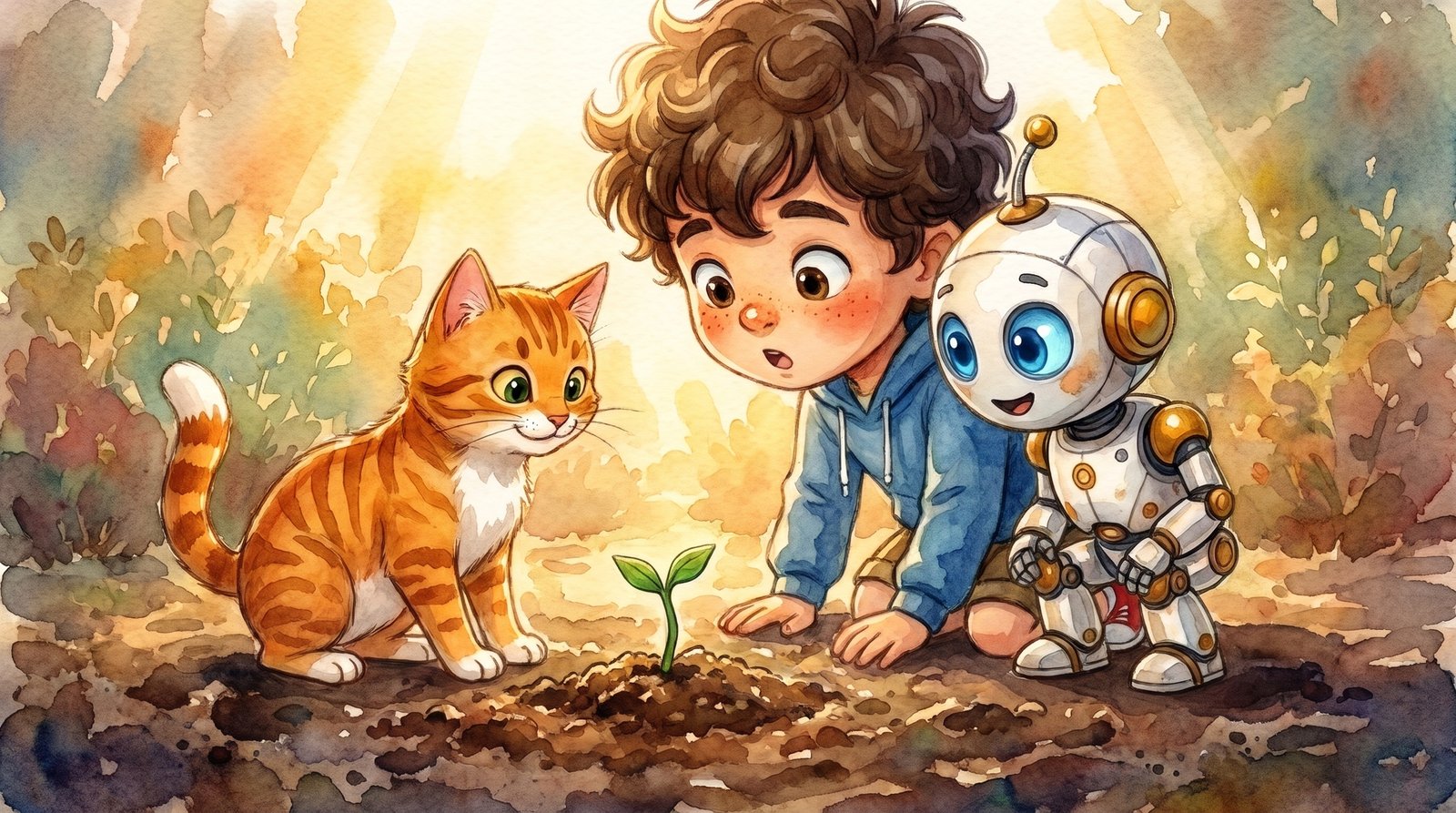
A small beginning worth looking closely at. Our illustrations imagine the trio’s garden; the story follows a bean seed’s journey.
1. The smallest thing in the bag
Leo tipped his explorer bag onto the table.
Out came a notebook, a pencil, a piece of string, and a packet of bean seeds.
Pip inspected the string.
Gidget inspected the packet.
Leo held one dry seed in his palm.
“It doesn’t look very busy.”
“There is a tiny young plant inside,” said Gidget. “It is called an embryo.”
Leo looked closer.
“A whole little beginning?”
“With stored food to help it start, and a protective covering called a seed coat.”
Leo imagined a tiny traveller with a coat and a packed lunch.
“An explorer!”
“A useful picture,” said Gidget. “Though a seed does not think about journeys as we do.”
Pip hooked the string with one paw. His own journey was already under way.
2. A place to begin
With a grown-up’s help, they filled a small pot with seed compost. There were holes underneath for extra water to drain away.
Leo checked the packet and planted the bean at the recommended depth.
Then he poured in a little water.
“Should I give it the whole jug?”
“Feel the compost first,” said Gidget.
It was damp.
“Enough for now. The seed needs water, but it also needs oxygen. If every little space stays flooded, too little air can reach it.”
“A drink, not a swimming pool.”
“Exactly. And a suitable temperature. Different seeds grow best in different conditions.”
They put the pot in a place suited to the packet’s instructions.
Leo made a label: BEAN. PLEASE GROW.
Then he waited.
He waited until after lunch.
He waited until Pip had finished washing one ear.
He waited a little longer.
“Perhaps it cannot read,” he said.
3. A change you cannot see
The next morning, the compost looked much the same.
“Nothing happened,” Leo said.
“Nothing above the surface,” said Gidget. “That is all we know yet.”
They prepared a second bean for watching: a seed beside a damp paper towel in a clear container with room for air, following their grown-up’s advice.
“This one can be our window,” Leo said. “So we don’t have to dig up the planted one.”
Over the next few days, the watching bean swelled.
“It’s taking in water,” said Gidget. “Inside, the conditions are allowing its growth processes to get going. Its stored food supplies materials and energy.”
“So it has started before we can see a leaf.”
“Yes. The beginning of a seed’s growth is called germination.”
Leo wrote the new word slowly.
Pip sat beside him, helping by not sitting on the bean.
4. The first white tip
One morning, Leo spotted a split in the watching bean’s coat.
A pale little tip had pushed through.
“A leaf!”
Gidget brought the magnifying glass.
“Look again.”
The tip was narrow and smooth, with no green blade.
“A root?”
“The first root. Scientists call it the radicle.”
“It starts by going down?”
“A young root usually grows in the direction of gravity. As it develops and branches, it helps anchor the plant and take in water and dissolved minerals.”
Leo imagined a tiny tent being pegged into the ground.
“Holding on before reaching up.”
He drew the white tip in his notebook.
This time, he wrote I CAN SEE A ROOT, instead of guessing what was happening everywhere inside.
5. The green surprise
Days passed. They checked the pot gently and kept the compost damp without soaking it.
Then the surface lifted in a little bump.
A curved shoot appeared.
“It’s here!” Leo whispered, as if a loud voice might push it back down.
Their bean’s curved stem grew upward and lifted its thick seed leaves above the compost. Gradually, the shoot straightened.
“Those thick parts are cotyledons,” said Gidget. “They held stored food for this bean’s beginning.”
More leaves began unfolding between them.
Leo bent low. Pip’s whiskers hovered nearby. Gidget knelt beside them.
Nobody tugged.
Nobody hurried it.
They simply looked.
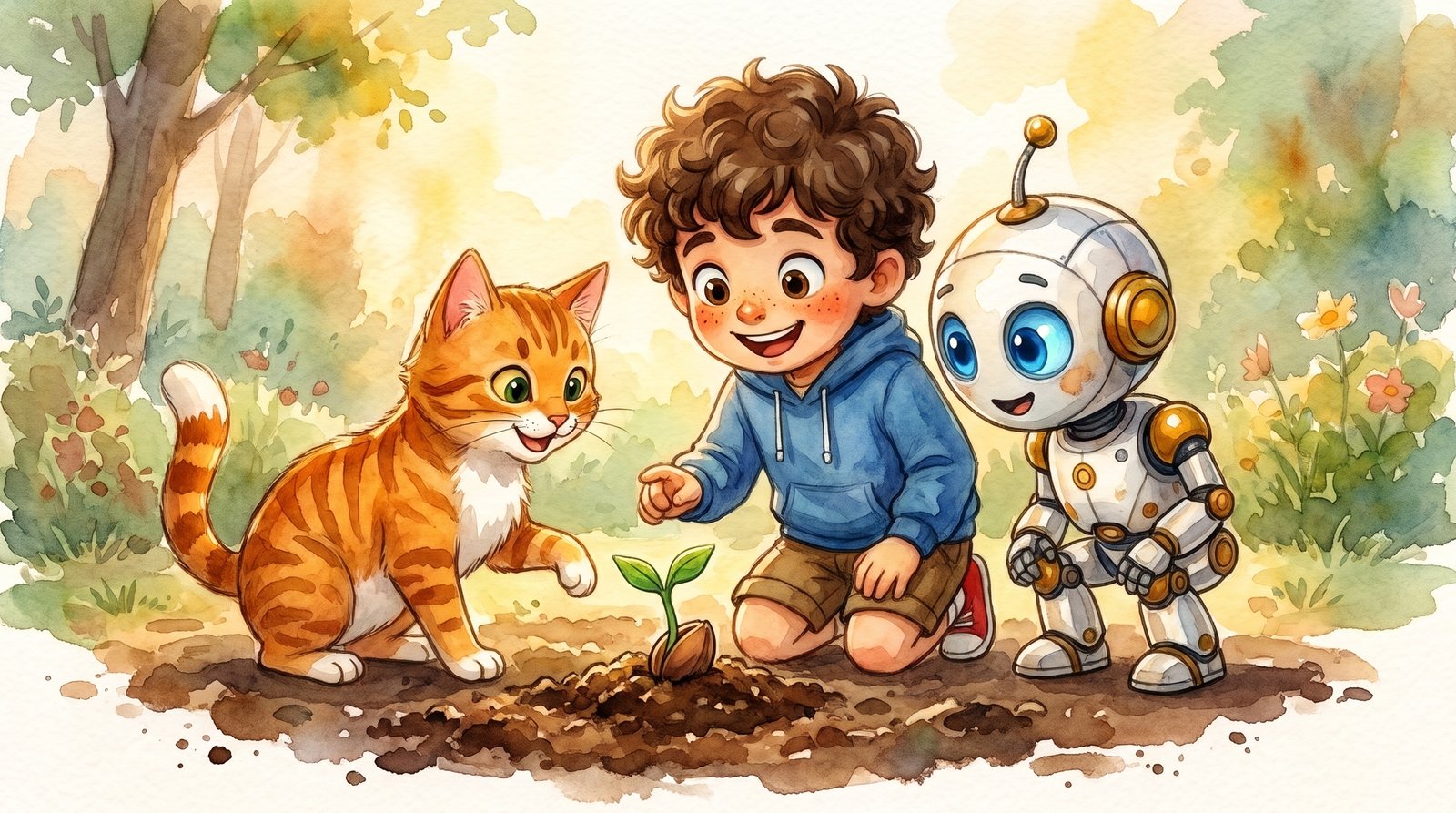
A shoot above the surface is the visible part of a bigger change. Roots have been growing out of sight, too.
“You are taller than yesterday,” Leo said.
For once, he was not speaking to Gidget.
6. The leaf’s new job
“Will its packed lunch last forever?” Leo asked.
“No,” said Gidget. “But as green leaves develop and receive enough light, they can make sugars.”
Leo studied a leaf.
“Where do the ingredients come from?”
“Water arrives through the roots. A gas called carbon dioxide comes from the air. Using light energy, the green parts of the plant turn water and carbon dioxide into sugars. This is photosynthesis.”
Leo tried the word in small pieces.
“Photo… synthesis.”
“The sugars provide material and a source of energy for the plant. Oxygen is released, too.”
“So sunlight helps it make food. It doesn’t eat the soil?”
“Right. Soil helps support it and supplies water and minerals. Much of the material in a growing plant comes from carbon dioxide in the air.”
Leo waved a hand through the invisible air.
“Some of a leaf’s building material was here?”
“Yes.”
He looked back at the tiny plant with new respect.
Invisible ingredients. Visible leaves.
7. Growing is more than getting taller
Soon the bean had another leaf.
And another.
Leo drew the leaves and measured the stem from the compost surface, using the same starting point each time.
“Yesterday it was shorter.”
“And today it has more than height,” Gidget said. “New cells are being made, and cells are growing. The plant is building roots, stems, and leaves.”
“A whole team of parts.”
“Roots take in water and minerals. Stems support the leaves and carry substances between parts. Green leaves use light to make sugars. Every living part also uses respiration to release energy from food.”
“Even at night?”
“Even at night. Photosynthesis needs light, but respiration continues in living plant cells day and night.”
Leo looked at Pip, who had fallen asleep in a patch of sunshine.
“Some members of our team are resting.”
Pip opened one eye.
Supervising was tiring work.
8. The seed that waited
Not every seed in their little experiment sprouted at the same time.
One still looked unchanged.
“Did we fail?” Leo asked.
“We have a question to investigate,” said Gidget. “Is it too dry? Too wet? Too cold? Does it need more time? Is the seed still alive?”
“Not every seed will grow?”
“Not every one. Some seeds need special conditions before they can germinate. Some have been damaged. Even seeds from one packet can behave differently.”
Leo put a small question mark beside its drawing.
He liked that better than a cross.
The bean in the pot kept growing. If it stayed healthy and had suitable conditions, it could later make flowers and pods containing new seeds.
“A beginning that can make more beginnings,” Leo said.
He took down his first label and turned it over.
On the back, he wrote:
GROWING HERE. SOME OF THE WORK IS HIDDEN.
Pip rubbed against his knee.
Gidget closed the notebook.
And the little green plant, without reading a single word, unfolded another leaf.
A little seed guide
Seed: A plant’s young beginning in a protective covering, usually with a food reserve. The young plant inside is the embryo. The seed coat protects it; it is not the same thing as the thick cotyledons inside a bean.
Germination: The beginning or resumption of embryo growth. A living seed needs water, oxygen, and a suitable temperature. Some species also have particular light or dormancy requirements. Sunlight is not a universal requirement for germination, even though green seedlings need suitable light for continued healthy growth.
Root and shoot: In our bean, the first root emerges before the leafy shoot appears. Roots generally grow downward in response to gravity; shoots generally grow upward, and many bend toward light. Neither needs a brain to respond: growth is regulated by the plant’s cells and chemical signals.
Stored food, then photosynthesis: The seed’s reserves support its early growth. As green leaves develop, photosynthesis uses light energy, water, and carbon dioxide to make sugars, releasing oxygen. Roots take in water and minerals; soil is not the plant’s main source of food.
Growth: A plant develops through cell division, cell enlargement, and the formation of different tissues. More roots or another leaf can matter as much as a taller stem. Seedlings have different shapes and schedules; not every seed follows our bean’s exact pattern.
Grow a little observation garden
- With a grown-up, choose a few bean seeds suitable for a classroom growing activity. Read the packet. Keep seeds and sprouts for observing, not eating; some planting seeds have treatments, and raw beans are not safe snacks.
- Place a folded, damp paper towel in a clear container. Put two or three beans between the towel and the side so you can see them. Keep the towel damp, not dripping, with access to air. Set it somewhere suitably warm, out of hot direct sunlight. Do not seal it airtight.
- Check each day. Draw what you can actually see: swelling, a split coat, a root, a shoot, or no visible change. Record the date rather than expecting every bean to sprout on a promised day.
- Once a bean has sprouted, have a grown-up help plant it carefully in a pot with drainage, following the seed instructions. Handle it gently and protect the root. Give the developing green seedling suitable light.
- Record new leaves and measure height from the same point. Check moisture rather than watering automatically. If mould appears, ask a grown-up to discard the affected material; do not sniff it closely. Wash your hands after handling seeds or compost.
Open Gidget’s growing notebook
Why can a seed begin growing before it has green leaves? It uses food already stored in the seed. Why not keep it underwater? Most familiar garden seeds need oxygen as well as water; waterlogging limits their oxygen supply. Does no visible shoot mean no change? No—early changes and root growth may be hidden. Is a plant that has not sprouted “lazy”? No. Its condition, its species, and its surroundings affect what happens.
A note for grown-up explorers
This is a simplified journey of a common garden bean, not a universal timetable or a species identification of the supplied artwork. The illustrations are stylised: their seed shapes and leaf arrangement should not be used as exact botanical diagrams. Different seeds keep reserves in different tissues. Common beans have two cotyledons that can be lifted above ground; peas keep theirs below ground, and grasses grow differently.
“Packed lunch” is a metaphor for stored reserves, not a claim that a seed chooses to prepare for the future. Water uptake starts important changes, but moisture alone does not make every seed germinate: viability and dormancy matter too. A seed already contains living cells; germination does not create life from a lifeless object.
Green plants both photosynthesise and respire. Light supplies energy, not the bulk of a plant’s physical material. Carbon dioxide and water supply raw materials for sugar production; minerals are also essential for healthy growth. Suitable care supports growth but cannot guarantee that every seed will survive.
Explore further: University of Illinois: germination · University of Minnesota: seed physiology · Minnesota DNR: sprouting time · NC State Extension: plant propagation · Smithsonian: photosynthesis and plant needs · Washington State University: plant growth and respiration